Meta Title: Blood Analyzer for Malaria-Associated Anemia in Children | RunMei
Meta Description: Malaria-associated anemia in children. How a blood analyzer at the malaria visit guides treatment, recheck and referral.
URL: https://runmeihealth.com/blood-analyzer-malaria-anemia-children
By Dr. Elena Marchetti · MD, MPH, Rural Health Diagnostics | Reviewed by Prof. Daniel Mwangi (PhD, MSc, Laboratory Systems Advisor) | Published: 2026-10-1
Twelve children tested positive for malaria at this clinic last week. The blood analyzer question — what it can do, what it costs to run and how a result earns trust — is answered in the pages that follow. Eleven went home with artemisinin therapy. None of them had a hemoglobin result, because the malaria rapid test does not measure blood, and the blood count lives two hours away. The treatment kills the parasite. The anemia gets discovered later, if at all. The 5-part differential blood analyzer catalog covers the instruments rural programs order most often.
This article looks at blood analyzer through the lens of rural health care, where the stakes are ordinary and the constraints are real: budgets that do not stretch, staff who already wear several hats, and distances that punish delay. The WHO’s World Malaria Report estimated 249 million malaria cases and 608,000 deaths in 2022, with children under five in Africa carrying the heaviest burden of severe disease and death. The practical questions — which instrument, what training, how much per test, who maintains it — are answered in plain language, with the numbers a procurement committee can actually use. WHO . Facilities weighing the options can browse the محلل أمراض الدم range to compare configurations side by side.
Key Takeaways
- Malaria and anemia travel together, and the second is often the deadlier of the two.
- A CBC at the malaria visit reveals anemia that changes the treatment plan.
- Severe anemia demands referral; mild anemia needs follow-up testing.
- The blood analyzer makes the malaria visit a complete assessment.
The Partner Nobody Treats
Malaria destroys red cells, and the anemia it causes can kill after the parasite is gone. The child who recovers from the fever but stays profoundly anemic is the child who returns in crisis weeks later. The malaria rapid test answers the question it is designed for; it cannot see the hemoglobin falling.
The blood count at the malaria visit closes that blind spot. The child with a positive test and a safe hemoglobin gets standard treatment and a follow-up date. The child with the same test and a hemoglobin of 6 g/dL gets something different: a referral, a transfusion decision, and a plan that treats both diseases.
the blood analyzer is the seed; the program is the tree. Training, supervision, registers, quality checks and a supply line that outlasts the donor — these are what turn a machine into a service that keeps running. Programs that design for sustainability from the first installation meeting are the ones still running at the five-year review. Programs built around blood analyzer see the effect within the first month. WHO . Programs that want a deeper differential can read the affordable blood analyzer page for the trade-offs.
The Second Visit That Never Happened
Malaria follow-up attendance is poor everywhere, which means the anemia will not be caught at a later visit. It must be caught at the first visit, at the same moment as the parasite — which is exactly what the on-site count allows.
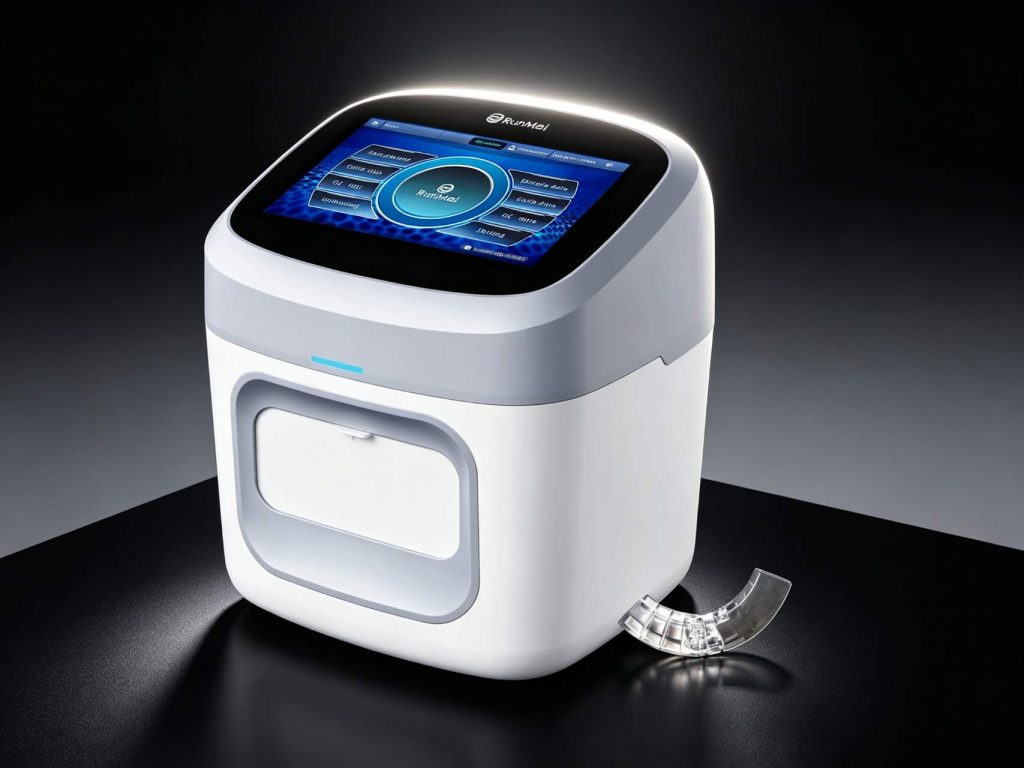
Fig. 1 — RunMei affordable blood analyze in a rural clinic setting. Blood analyzer malaria anemia children rural clinic. | Alt: blood analyzer malaria anemia children rural clinic
What the Count Changes in the Malaria Protocol
A three-band protocol turns the count into action. Above the safe threshold: treat malaria, reassure, and schedule a routine recheck. Between the thresholds: treat malaria, add follow-up testing within two weeks, and counsel the family on iron-rich food. Below the severe threshold: refer with the result attached, because severe anemia with malaria is a transfusion-requiring emergency.
The protocol also protects the referral system from overuse. Not every anemic child needs the district hospital; the count is what separates the ones who do from the ones who can be managed locally. Without the number, the clinician either refers everyone or refers no one.
The community decides whether the blood analyzer lives or decorates. A machine that sits in a room patients do not enter is a machine without value; a machine that is explained, trusted and used is a service. Programs that involve community health workers, explain results in the local language and let the community see the benefit get the utilization that makes the whole investment real. The same principle holds for blood analyzer: measure, record, act. Budget teams should see the open channel CBC analyzer cost analysis before signing off on procurement.
The 14-Day Recheck
Mild anemia after malaria should be rechecked at two weeks, when the hemoglobin should be climbing. The recheck is the evidence that the child is recovering; the analyzer makes the recheck possible at the local clinic.
Building the Combined Assessment Into the Visit
The combined malaria-and-count visit is not slower; it is the same visit with one more step. The malaria test takes fifteen minutes anyway, and the count takes ten. Running them together means the clinician closes the consultation with both answers — parasite status and blood status — instead of half the picture.
The habit starts on day one of the malaria season. The clinic that tests both from the first case keeps testing both; the clinic that starts by testing only malaria finds it very hard to add the second test mid-season.
The numbers have to close in the real world. Volume assumptions, fee structures, reagent costs and the hidden cost of the journey patients would otherwise make — each belongs in the model before the purchase, not after. Facilities that run the arithmetic honestly find the blood analyzer is not an expense; it is the cheaper way to do what they were already doing. blood analyzer is the instrument at the center of that workflow.
The Season Start Rule
On the first day of the high transmission season, post the protocol and run the control early. The combined assessment is a seasonal discipline, and disciplines are set at the start of the season, not in the middle of it.

Fig. 2 — RunMei open channel CBC analyzer during routine testing. Hematology analyzer hemoglobin check malaria visit. | Alt: hematology analyzer hemoglobin check malaria visit
The Implementation Checklist
blood analyzer pays off when the installation is treated as a project, not a delivery. The checklist has eight lines: site preparation (space, power, bench); operator selection and training dates; control materials ordered with the blood analyzer; a named maintenance owner; a register designed before the first test; a referral protocol agreed with the district; a reagent supply line with buffer stock; and a review date at 90 days. Each line is a name and a date, not a good intention.
The 90-Day Review
The first three months decide the trajectory. The 90-day review should read the register: how many tests, what findings, which problems, what was fixed. Facilities that review honestly adjust — retraining where errors show, reagent reordering where supply slipped, protocols tightened where referrals misfired. The review is where a good installation becomes a good service.
Scaling From One Machine
One working instrument is the argument for the next. When the first clinic’s register shows the volume and the outcomes, the case writes itself: the same training package, the same quality framework, the same supply line extended to the next facility. Programs scale on demonstrated results rather than meetings — and the demonstrated results start at the first bench.
Decisions about malaria anemia children are usually made at district level — and the register feeds them. It also strengthens post-malaria hemoglobin, a benefit that rarely appears in the budget line. None of this holds together without attention to severe anemia referral. That is the practical reality of blood analyzer in the field.
الأسئلة المتداولة
Q1. Why test hemoglobin in a child with malaria?
Malaria destroys red cells, and the resulting anemia can be life-threatening even after the parasite is treated. The count at the first visit catches it.
Q2. Does every anemic child with malaria need referral?
No. Mild anemia is managed locally with treatment and a two-week recheck; only severe anemia, below the protocol threshold, requires referral.
Q3. Can the blood analyzer detect the malaria parasite?
No. The rapid diagnostic test or blood film detects the parasite; the analyzer measures the blood’s response, which is exactly the information the treatment plan needs.
Q4. How soon should hemoglobin be rechecked after malaria?
Within two weeks for mild anemia, when the count should show recovery; persistent or worsening anemia requires investigation.
Sources & References
- The WHO’s World Malaria Report estimated 249 million malaria cases and 608,000 deaths in 2022, with children under five in Africa carrying the heaviest burden of severe disease and death. Source: WHO — https://www.who.int/news-room/fact-sheets/detail/malaria
- WHO analyses indicate that anemia affects roughly one in four people worldwide, with the highest prevalence in preschool children and pregnant women in low- and middle-income regions. Source: WHO — https://www.who.int/news-room/fact-sheets/detail/anaemia
About the Author & Reviewer
Author: Dr. Elena Marchetti, MD, MPH, Rural Health Diagnostics. Dr. Marchetti is a physician and diagnostics specialist who has spent the past fifteen years designing point-of-care programs for district hospitals and rural clinics in lower-resource settings. Her field work focuses on how laboratory devices survive daily use outside the laboratory, from staff training to reagent logistics.
Reviewer: Prof. Daniel Mwangi, PhD, MSc, Laboratory Systems Advisor. Prof. Mwangi directs laboratory quality programs for a network of rural health facilities and teaches clinical laboratory science. He has reviewed point-of-care device deployments across Africa and Southeast Asia, with a particular interest in quality control and operator competency outside the main laboratory.
Disclaimer
This article is for informational and marketing purposes only and does not constitute medical advice, a product claim, or a regulatory certification statement. Device availability, regulatory status (FDA 510(k)/CE/ISO 13485) and specifications vary by country and model; always verify current approvals with the manufacturer and consult local regulations before procurement or use.