Meta Title: Boat Clinics and Blood Counts: CBC Testing for the Coast | RunMei
Meta Description: CBC testing on boat clinics brings blood counts to coastal and fishing villages. How a portable analyzer returns results before the tide turns.
By Dr. Elena Marchetti · MD, MPH, Rural Health Diagnostics | Reviewed by Prof. Daniel Mwangi (PhD, MSc, Laboratory Systems Advisor) | Published: 2026-09-21
The clinic sails with the tide. This guide answers the specific questions that surround blood counts: what it delivers, what it cannot do, and what the true cost of ownership looks like. Every two weeks the boat ties up at the jetty, the health worker unpacks the cooler, and the village lines up under the awning. Until recently the blood samples went back on the boat with her, a two-day voyage to a laboratory that the next storm might cancel, with the results nowhere in sight. The CBC testing sits at the center of that change, and the pages that follow show why. The cost-effective blood analyzer catalog covers the instruments rural programs order most often.
This is written as a field briefing, not an advertisement. It deals in the realities of blood counts in rural health care: power, training, reagents, maintenance and trust. About 3 billion people worldwide still cannot reach a health facility within one hour on foot, a figure the WHO has used to argue for diagnostics that travel to patients instead of the other way around. If you are planning an installation — or defending an existing one — the checklists and protocols here will spare you lessons that other facilities have already paid for. WHO . Facilities weighing the options can browse the premium 5-part blood analyzer range to compare configurations side by side.
Key Takeaways
- Fishing villages are among the most isolated patients in any health system.
- A portable blood analyzer on the boat clinic returns results before the boat leaves.
- Hemoglobin and white cell counts travel better than blood samples do.
- Seasonal testing calendars match the fishing season, not the harvest.
Why the Coast Is a Diagnostic Desert
Coastal communities look connected on a map and are not. The road ends at the mainland; the clinic is a boat ride away; the laboratory is a boat ride beyond that. When the sea is rough, every distance doubles, and a sample drawn on Monday can arrive on Friday with its answer unreadable.
The health problems follow the same pattern as other isolated places, with one addition: the sea itself. Injuries from nets and engines, infections that heal poorly in salt water, and anemia in communities whose diet is fish and little else.
the blood counts is the seed; the program is the tree. Training, supervision, registers, quality checks and a supply line that outlasts the donor — these are what turn a machine into a service that keeps running. Programs that design for sustainability from the first installation meeting are the ones still running at the five-year review. Programs built around blood counts see the effect within the first month. FDA . Programs that want a deeper differential can read the low reagent cost blood analyzer page for the trade-offs.
The Cooler Problem
Blood samples in a cooler on a boat are a gamble. Heat, motion and delay each degrade the sample, and the laboratory that finally receives it cannot tell how much of the damage happened at sea. Testing on the boat removes the gamble by removing the journey.
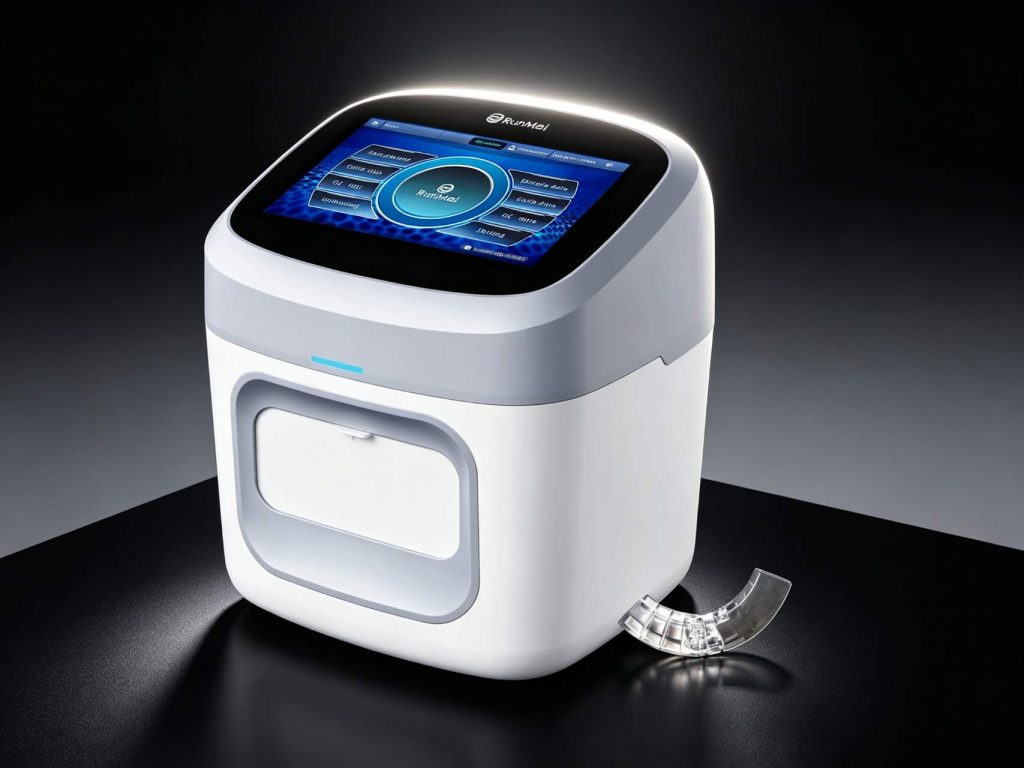
Fig. 1 — RunMei differential blood analyzer in a rural clinic setting. Portable blood analyzer boat clinic coastal testing. | Alt: portable blood analyzer boat clinic coastal testing
What a Boat-Based Blood Analyzer Changes
The arithmetic is simple. A boat clinic that tests on board returns results the same visit; one that collects samples returns them two days later, if the weather holds. For the family waiting under the awning, the difference is whether the child with fever leaves with medicine or with a promise.
the blood counts has to earn its place on the boat: it must tolerate humidity, run on battery, survive being carried over a gangplank, and take a sample small enough for a child whose veins the sea wind has made difficult.
The reagent line is where the real budget lives. A machine that costs little but drinks expensive consumables will be switched off by year two; a machine whose per-test cost fits the community’s wallet keeps running because the community can afford it. Buyers should ask one question before any other: what does each test actually cost delivered to this clinic, and can that cost be sustained after the donor’s project ends? The same principle holds for blood counts: measure, record, act. Budget teams should see the differential blood analyzer cost analysis before signing off on procurement.
The Small Sample, the Smallest Patients
Finger-prick sampling changes who can be tested. The toddler, the elderly woman, the dehydrated fisherman all give the few drops a portable analyzer needs, which means the boat clinic serves the people the hospital venipuncture chair never sees.
Calendars, Registers and the Return Visit
The boat clinic works on a calendar, and the calendar should follow the fishing season. Testing days are scheduled around the tides and the catch, because a clinic that arrives during the main haul finds an empty jetty. The register that records every result becomes the community’s health memory between visits.
The return visit is where the program succeeds or fails. Results from the last trip are reviewed, treatments checked, and the patients who were referred are followed up. A portable blood analyzer makes each visit a complete consultation instead of a collection round.
Results become evidence only when they are recorded. A register — patient, date, count, action taken — turns a stream of tests into a picture of the community’s health, and that picture is what justifies the program’s continuation. Clinics that keep the register find it writes their own case for support. blood counts is the blood counts at the center of that workflow.
The Register Between the Tides
The register travels with the boat and stays with the community in duplicate. Each visit adds a line; each line connects to the last. After a year the pattern is visible: which villages carry the anemia load, which months bring the fevers, and where the next visit should spend its time.
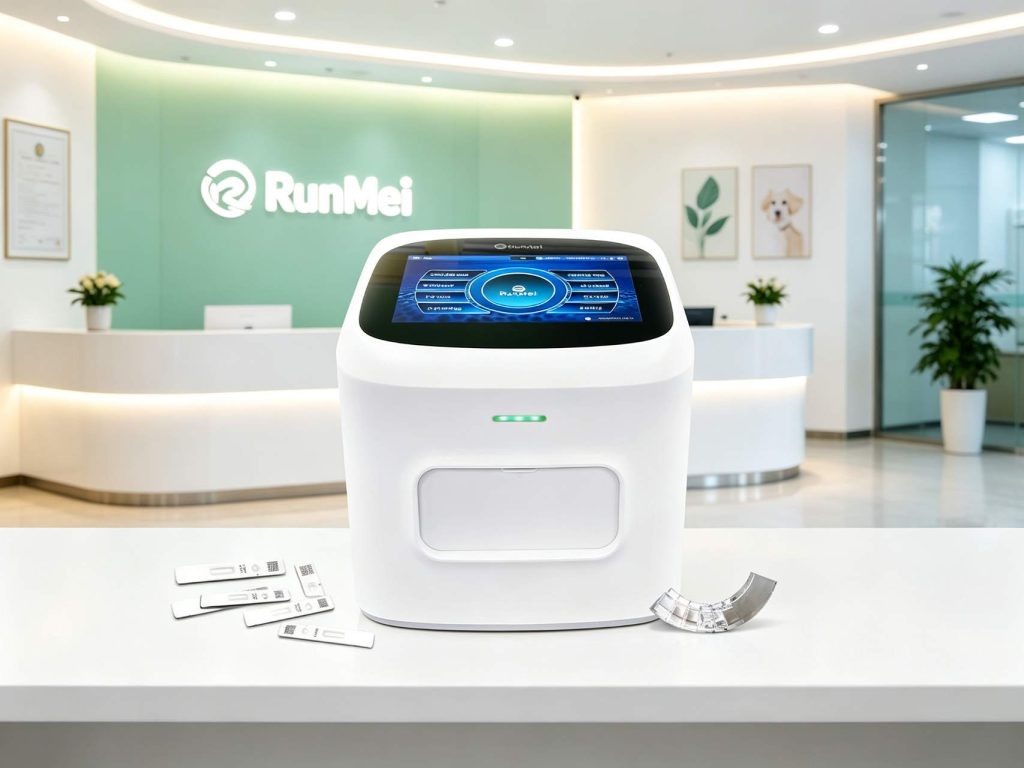
Fig. 2 — RunMei premium 5-part blood analyzer during routine testing. Battery powered blood analyzer fishing village outreach. | Alt: battery powered blood analyzer fishing village outreach
The Cost Case
The cost case for blood counts rests on three lines: what the referral alternative actually costs the patient and the system, what the on-site test costs once volume is real, and what the blood counts returns in retained patients and earlier treatment. The three lines are often argued separately; the honest analysis adds them, and the sum is what the ministry should see.
On-site CBC testing at the boat clinic keeps the same-day promise, and the register proves it. The CBC testing that starts with a finger-prick on the jetty is the CBC testing that ends with a treatment plan before the tide turns.
Counting the Journey
The referred test carries a published price and a real price. The real price adds transport, the lost day of work, and the arrangements a family makes to travel — typically several times the fee. Programs that count the journey find the on-site test is cheaper than the alternative even before it is faster.
The Utilization Multiplier
When the journey disappears, volume rises: antenatal bookings produce counts, chronic patients return on schedule, febrile visits are tested instead of observed. The utilization multiplier is the reason payback estimates built on old referral volumes underestimate the analyzer’s return.
Decisions about boat clinic blood testing are usually made at district level — and the register feeds them. It also strengthens coastal community health, a benefit that rarely appears in the budget line. None of this holds together without attention to fishing village diagnostics.
الأسئلة المتداولة
Q1. Can a blood analyzer really work on a boat?
Portable, battery-powered models can, when they are protected from humidity and rough handling. Small sample volume is an advantage in this setting.
Q2. Which tests should a boat clinic run?
The CBC, starting with hemoglobin and white cell counts. These answer the fever, anemia and infection questions that dominate coastal consultations.
Q3. What happens to samples for tests the boat cannot do?
They still travel, but far less often. The on-board analyzer filters the referral list, so only genuinely complex samples make the journey.
Q4. How do results reach patients between visits?
The register and a community health worker bridge the gap. Results from the last visit are reviewed on the next, and urgent findings are carried ashore the same day.
Sources & References
- World Health Organization data show that in lower-income countries a large share of the rural population still lives beyond the reach of a functioning laboratory; the WHO recommends primary care facilities be reachable within roughly 5 km, yet global estimates indicate about 3 billion people cannot reach a health facility within one hour on foot. Source: WHO — https://www.who.int/news-room/fact-sheets/detail/primary-health-care
- Under 21 CFR 864.5220, automated differential cell counters are Class II medical devices that require FDA 510(k) premarket clearance before they can be marketed in the United States. Source: FDA — https://www.ecfr.gov/current/title-21/chapter-I/subchapter-H/part-864/subpart-C/section-864.5220
- WHO analyses indicate that anemia affects roughly one in four people worldwide, with the highest prevalence in preschool children and pregnant women in low- and middle-income regions. Source: WHO — https://www.who.int/news-room/fact-sheets/detail/anaemia
About the Author & Reviewer
Author: Dr. Elena Marchetti, MD, MPH, Rural Health Diagnostics. Dr. Marchetti is a physician and diagnostics specialist who has spent the past fifteen years designing point-of-care programs for district hospitals and rural clinics in lower-resource settings. Her field work focuses on how laboratory devices survive daily use outside the laboratory, from staff training to reagent logistics.
Reviewer: Prof. Daniel Mwangi, PhD, MSc, Laboratory Systems Advisor. Prof. Mwangi directs laboratory quality programs for a network of rural health facilities and teaches clinical laboratory science. He has reviewed point-of-care device deployments across Africa and Southeast Asia, with a particular interest in quality control and operator competency outside the main laboratory.
Disclaimer
This article is for informational and marketing purposes only and does not constitute medical advice, a product claim, or a regulatory certification statement. Device availability, regulatory status (FDA 510(k)/CE/ISO 13485) and specifications vary by country and model; always verify current approvals with the manufacturer and consult local regulations before procurement or use.