Meta Title: Flood-Resilient Blood Testing: CBC After Cyclones | RunMei
Meta Description: Flood-resilient blood testing keeps the CBC running when roads and power fail. How a clinic analyzer answers anemia and fever questions during disaster response.
By Dr. Elena Marchetti · MD, MPH, Rural Health Diagnostics | Reviewed by Prof. Daniel Mwangi (PhD, MSc, Laboratory Systems Advisor) | Published: 2026-09-20
The water reached the clinic on a Tuesday night, and by Wednesday morning the laboratory was a reference point for what had been lost. The flood-resilient blood testing question — what it can do, what it costs to run and how a result earns trust — is answered in the pages that follow. The district lab sat on higher ground, but the road to it was gone. For the next three weeks, every hemoglobin, every white cell count, every result that the community needed had to be produced somewhere else, or not at all. The medical blood analyzer catalog covers the instruments rural programs order most often.
This article looks at flood-resilient blood testing through the lens of rural health care, where the stakes are ordinary and the constraints are real: budgets that do not stretch, staff who already wear several hats, and distances that punish delay. According to the WHO, health facilities serving close to one billion people in low- and middle-income countries lack reliable electricity or have none at all — roughly 12% of facilities in South Asia and 15% in sub-Saharan Africa are completely unelectrified. The practical questions — which instrument, what training, how much per test, who maintains it — are answered in plain language, with the numbers a procurement committee can actually use. WHO . Facilities weighing the options can browse the portable blood analyzer range to compare configurations side by side.
Key Takeaways
- Floods isolate communities from district laboratories for weeks at a time.
- A blood analyzer on the clinic bench survives the storm better than the road to the lab does.
- Portable analyzers run on batteries, tolerate humidity, and test while the water is still receding.
- Disaster plans that include on-site CBC testing keep anemia, fever and infection care alive.
What a Flood Does to the Testing Chain
A flood does not just close a laboratory; it closes every step around it. Transport is the first casualty, which means samples cannot travel. Power is the second, which means even a surviving lab cannot run. The two failures together turn a week of heavy rain into a month without results.
The patients who suffer most are the ones who were already vulnerable: pregnant women needing hemoglobin checks, children with fever, and chronic patients whose monitoring schedules do not pause for weather.
the flood-resilient blood testing is the seed; the program is the tree. Training, supervision, registers, quality checks and a supply line that outlasts the donor — these are what turn a machine into a service that keeps running. Programs that design for sustainability from the first installation meeting are the ones still running at the five-year review. That is the practical reality of flood-resilient blood testing in the field. WHO . Programs that want a deeper differential can read the premium 5-part blood analyzer page for the trade-offs.
The Road, the Power, and the Result
Disaster planners often map roads and power lines, but they rarely map the testing chain. The clinic that can draw blood but cannot send it, and the lab that can run tests but cannot receive samples, are two halves of a service that no longer connects. On-site testing reconnects them inside one building.
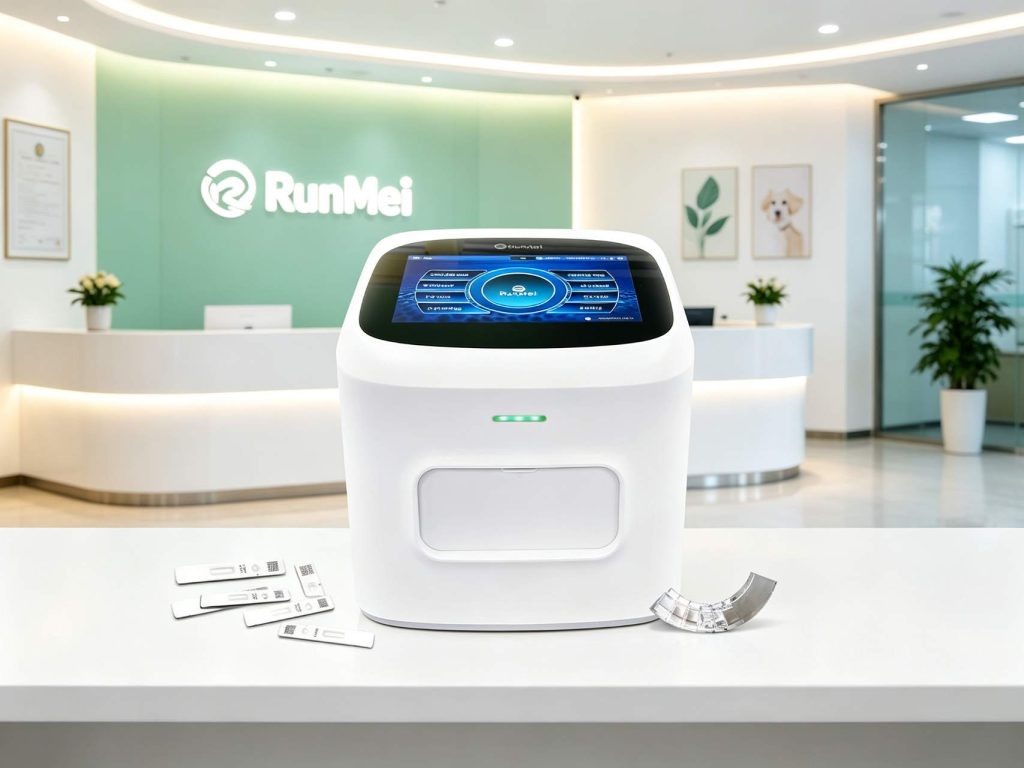
Fig. 1 — RunMei premium 5-part blood analyzer in a rural clinic setting. Blood analyzer flood resilient rural clinic testing. | Alt: blood analyzer flood resilient rural clinic testing
Why a Portable Blood Analyzer Belongs in the Flood Plan
The instruments that keep working in a flood zone share three traits: they run on battery or solar, they need no running water, and they tolerate humidity without drifting. A portable blood analyzer fits all three, which is why disaster-response teams carry them into the field rather than waiting for the laboratory to reopen.
The CBC is the right test for the aftermath of a flood. Malaria and waterborne fever return with standing water, anemia follows missed meals, and infections cluster where people shelter together. All of them show up in the blood count.
None of this happens without people. The clinic that treats the flood-resilient blood testing as a machine buys a machine; the clinic that treats it as a skill builds a capability. Operators need a hands-on competency pathway, a named backup for every shift, and refresher sessions that follow staff turnover — because in rural health care, the person trained last year may be the person who left, and the person answering for today’s results is the one who was never trained at all. And this is exactly where flood-resilient blood testing changes the decision. Budget teams should see the cost-effective blood analyzer cost analysis before signing off on procurement.
Testing While the Water Is Still Receding
The clinic that has its own analyzer does not wait for the road. It tests the patient in front of it, records the result, and treats what the count shows. The relief teams that arrive later find a clinic that kept its data, not a black box that lost its memory.
Building the Flood-Ready Testing Workflow
Flood readiness is a written plan, not a hope. The plan names the battery stock, the water tanks, the backup operator, and the alternative referral route for the rare tests the clinic cannot do. It also names the first tests to stop, because no clinic can do everything with solar power alone.
The same plan gets rehearsed. Clinics that run an annual flood drill find their gaps before the water finds them: the connector that does not fit, the reagent that was not rotated, the operator who was on leave.
Power is the silent partner in every rural deployment. In rural health care, outages are not the exception; they are the schedule. The practical answer is a flood-resilient blood testing that tolerates the interruption — battery capability that finishes the test in progress, a startup that does not lose calibration, and a surge protector between the wall and the machine. Programs that budget for power, not just for the instrument, are the programs whose instruments stay alive. Programs built around flood-resilient blood testing see the effect within the first month.
The Result That Travels With the Patient
When evacuation does happen, the paper result travels in the patient’s hand. The receiving hospital reads the count taken during the flood, compares it with its own, and treats the difference as information. That continuity is worth as much as any single number.

Fig. 2 — RunMei cost-effective blood analyzer during routine testing. Portable blood analyzer disaster response battery power. | Alt: portable blood analyzer disaster response battery power
The Implementation Checklist
flood-resilient blood testing pays off when the installation is treated as a project, not a delivery. The checklist has eight lines: site preparation (space, power, bench); operator selection and training dates; control materials ordered with the flood-resilient blood testing; a named maintenance owner; a register designed before the first test; a referral protocol agreed with the district; a reagent supply line with buffer stock; and a review date at 90 days. Each line is a name and a date, not a good intention.
The 90-Day Review
The first three months decide the trajectory. The 90-day review should read the register: how many tests, what findings, which problems, what was fixed. Facilities that review honestly adjust — retraining where errors show, reagent reordering where supply slipped, protocols tightened where referrals misfired. The review is where a good installation becomes a good service.
Scaling From One Machine
One working instrument is the argument for the next. When the first clinic’s register shows the volume and the outcomes, the case writes itself: the same training package, the same quality framework, the same supply line extended to the next facility. Programs scale on demonstrated results rather than meetings — and the demonstrated results start at the first bench.
The same logic applies to flood resilient diagnostics, which clinics in the region often underestimate. For teams accountable for disaster response clinic, the practical effect shows up within the first month. Decisions about portable blood analyzer disaster are usually made at district level — and the register feeds them. flood-resilient blood testing is the instrument at the center of that workflow.
الأسئلة المتداولة
Q1. Can a blood analyzer really keep working during a flood?
Battery-powered portable models can, provided reagents are protected and the room stays dry. The analyzer itself is small enough to move to high ground quickly.
Q2. Which tests matter most in the weeks after a flood?
The CBC answers the highest-priority questions: malaria and bacterial fever, anemia from missed meals and blood loss, and infection markers in crowded shelters.
Q3. How do reagents survive a flood?
Store them high, keep the fridge log, and treat any reagent that got warm or wet as suspect. Daily quality control after the event confirms the analyzer is still trustworthy.
Q4. Does disaster planning change which analyzer to buy?
Yes. Battery life, water resistance, low power draw and simple maintenance become deciding factors when the alternative is no laboratory at all.
Sources & References
- According to the WHO, health facilities serving close to one billion people in low- and middle-income countries lack reliable electricity or have none at all, with roughly 12% of facilities in South Asia and 15% in sub-Saharan Africa completely unelectrified. Source: WHO — https://www.who.int/health-topics/electrification-of-health-facilities
- World Health Organization data show that in lower-income countries a large share of the rural population still lives beyond the reach of a functioning laboratory; the WHO recommends primary care facilities be reachable within roughly 5 km, yet global estimates indicate about 3 billion people cannot reach a health facility within one hour on foot. Source: WHO — https://www.who.int/news-room/fact-sheets/detail/primary-health-care
- Reviews published in the New England Journal of Medicine have repeatedly underlined that the single most reliable way to improve outcomes in low-resource settings is to shorten the interval between clinical presentation and a correct laboratory diagnosis. Source: NEJM — https://www.nejm.org/
About the Author & Reviewer
Author: Dr. Elena Marchetti, MD, MPH, Rural Health Diagnostics. Dr. Marchetti is a physician and diagnostics specialist who has spent the past fifteen years designing point-of-care programs for district hospitals and rural clinics in lower-resource settings. Her field work focuses on how laboratory devices survive daily use outside the laboratory, from staff training to reagent logistics.
Reviewer: Prof. Daniel Mwangi, PhD, MSc, Laboratory Systems Advisor. Prof. Mwangi directs laboratory quality programs for a network of rural health facilities and teaches clinical laboratory science. He has reviewed point-of-care device deployments across Africa and Southeast Asia, with a particular interest in quality control and operator competency outside the main laboratory.
Disclaimer
This article is for informational and marketing purposes only and does not constitute medical advice, a product claim, or a regulatory certification statement. Device availability, regulatory status (FDA 510(k)/CE/ISO 13485) and specifications vary by country and model; always verify current approvals with the manufacturer and consult local regulations before procurement or use.