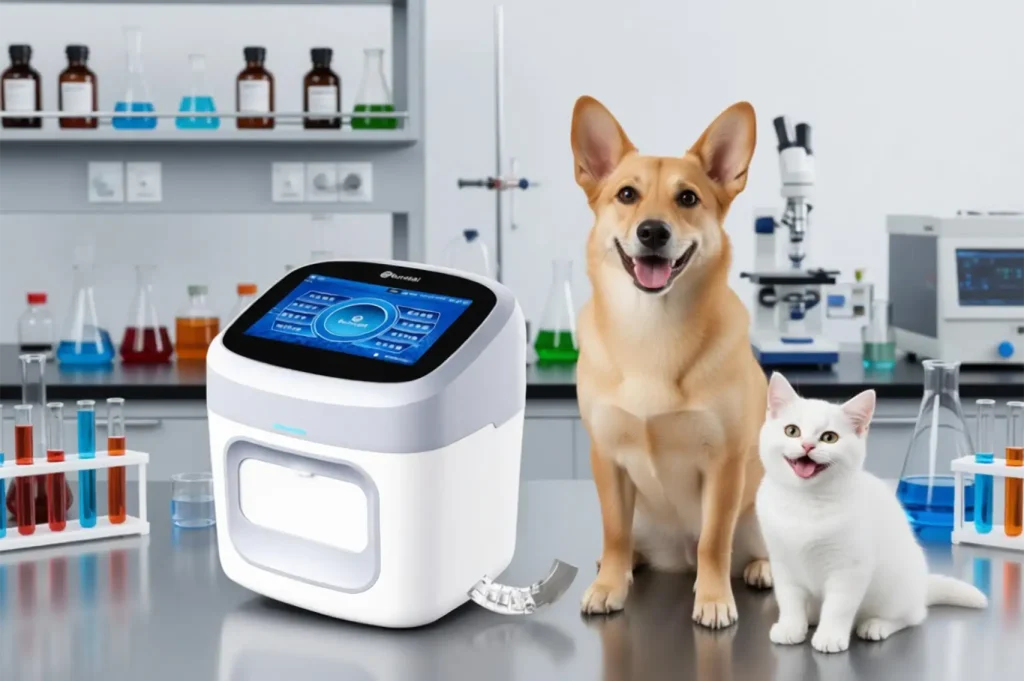
You do not need a university-trained laboratory scientist to run a modern blood analyzer. Say that at a ministry meeting and watch the room divide. The assumption that only degreed professionals can touch laboratory equipment has shaped policy for decades, and in rural Africa and Asia its quiet cost is enormous: clinics without working instruments, samples traveling for hours toward distant cities, and a diagnostics gap the Lancet Commission measured at 47 percent of the world’s population having little or no access to diagnostics (The Lancet Commission on Diagnostics, 2021).
Modern hematology analyzers have automated almost everything that once demanded specialist skill. What they ask of their operators is not expertise. It is discipline: careful sample technique, honest quality control, consistent cleaning, and the humility to escalate what they do not understand. Those are trainable behaviors, and community health workers learn them well.
The Workforce Shortage That Forced the Question
Laboratory scientists are scarce where they are needed most. The same Lancet Commission analysis found that only 19 percent of people in low- and lower-middle-income countries can access even the simplest diagnostic tests at primary care level, and specialist laboratory staff are concentrated in cities precisely because that is where the laboratories are. Waiting for enough qualified scientists to staff village clinics is not a plan. It is a postponement.
Task-shifting is the accepted name for the alternative: deliberately training non-specialist health workers to perform defined tasks with defined supervision. World Health Assembly Resolution WHA76.5 (2023) urged member states to strengthen diagnostic capacity at the primary care level, and in most low-resource settings that capacity will be built on task-shifted staff or not built at all.
What the Evidence Says About Task-Shifting
The evidence base has matured. Researchers writing in the New England Journal of Medicine have reported that shifting diagnostic tasks, including point-of-care blood testing, to trained non-specialist health workers in rural low- and middle-income settings can produce reliable results when training is structured and supervision is genuine. The stakes are high: the Lancet Commission estimates that closing the diagnostic gap for six priority conditions could avert around 1.1 million premature deaths every year.
The qualifier matters. Task-shifting fails when it means handing over a box and a brochure. It succeeds when it is a designed program with a curriculum, a competency checklist, and someone accountable for reviewing the work. The rest of this article describes what that program looks like for a hematology analyzer.
What a Health Worker Does With a Hematology Analyzer Each Day
The Daily Workflow
Strip away the anxiety and the job is remarkably concrete. The operator identifies the patient, collects the sample correctly, loads it, records the result, files it, cleans the instrument, and locks the reagent cabinet. Modern instruments carry much of the technical load themselves: an easy-to-use hematology analyzer with guided on-screen steps and automated self-checks reduces what training must cover and shrinks the space for handling errors. In deployments across rural clinics, the difference between a confident operator and a hesitant one is rarely talent. It is repetition with a supervisor nearby for the first few weeks.
Handling Samples Safely
Safety training comes first, not last. Gloves for every collection, safe sharps disposal, correct capillary technique, proper labeling, and the rule that any spill or exposure is reported the same day. Community health workers already handle blood in HIV and malaria testing programs, so the biosafety foundation usually exists; the analyzer training builds on it rather than starting from zero.
Designing Training That Sticks
A Four-Week Competency Plan
A practical structure runs four weeks. Week one covers biosafety, sample collection and the anatomy of a CBC report. Week two moves to supervised operation on the actual instrument, including daily controls. Week three is independent operation with review of every result by a supervisor. Week four closes with the competency assessment, maintenance duties, and escalation drills. Shorter exists, but four weeks produces operators who still trust themselves six months later.
Language and literacy shape the curriculum as much as content. Interfaces in a second language slow operators and breed silent errors, so materials should exist in the language staff actually use, with pictorial job aids beside the instrument. Programs that translate the checklist and the error-code table in week one avoid a year of small avoidable mistakes.
The Competency Checklist
- Performs finger-prick and venous sampling correctly on the first attempt
- Runs daily control material and records the results honestly
- Recognizes common error codes and responds with the basic steps
- Cleans and maintains the instrument to the published schedule
- Stops and escalates when results look impossible for the patient
- Keeps the reagent log current and reports stock before it runs out
Equipment choice shapes the training burden. An analyzer with simple training requirements lets programs shorten the curriculum and rebuild competence quickly after staff turnover. Our field notes on training community health workers on blood cell counters include sample curricula and the checklist above in printable form.
Supervision: The Ingredient Training Alone Cannot Replace
Quality Control Without a Pathologist
Quality control sounds intimidating until it is designed for the setting. In practice: run control material on schedule, record the values, flag anything outside the expected range, and stop testing until it is resolved. A district laboratory technologist reviews the logs monthly, either in person or through whatever connectivity exists. Refresher days twice a year catch the drift that creeps in quietly.
Supervision also has a human side. Operators who fear blame hide errors; operators who are coached report them. Programs that treat a reported fault as good practice, not failure, keep their instruments reliable and their data trustworthy. Staff turnover deserves planning too: because two trained operators per site is the minimum, every departure should trigger the curriculum, not a crisis.
Documents matter here. A one-page standard operating procedure beside the instrument, signed and dated after each review, does more for consistency than any workshop. When the district technologist visits, the review starts with the SOP and the logbook, and both should match what the operator actually does.
What the Hematology Analyzer Itself Must Bring
Training succeeds only when the machine meets it halfway. Instruments for task-shifted settings need guided workflows, clear error messages, robust construction and dependable consumables. Brand A, Brand B and Brand C all market to this segment, so procurement teams should score each option on the operator experience, not just the datasheet. RUNMEI Health designs its 3-part and 5-part AI-powered hematology analyzers, including the BCA-330 automatic hematology analyzer and the BCA-320 portable multi-function analyzer, for exactly these conditions, with ISO 13485-certified, CE and FDA-aligned manufacturing, 24/7 technical support, reagent supply programs, and OEM/ODM arrangements for program implementers and distributors.
Ask every supplier the same question: walk us through the operator’s day, step by step. If the answer needs a laboratory scientist in the room, the instrument is not ready for a village health post.
The Wider Payoff: TB Programs, Data and Trust
Once a health worker can run a blood analyzer, the clinic’s whole diagnostic posture changes. Blood counts support tuberculosis case-finding pathways as a first-level screen, flagging the anemia and inflammatory patterns that move a chronic cough from the worry list to the referral list, as we describe in tuberculosis case finding with blood counts in rural areas. The same daily discipline feeds program data upward, giving districts evidence of anemia trends, infection patterns and referral follow-through.
There is a quieter payoff too. When a village sees its own health worker produce a printed blood count, the clinic’s standing rises. Families stop rationing their visits. That trust is an asset no datasheet lists, and it compounds.
None of this happens overnight. Programs report the pattern repeating: competent operators build steady testing volume, steady volume builds a data record, and the data record is what convinces the district to budget for reagents the following year. Training is the first domino, and it is the cheapest one to tip.
Frequently Asked Questions
How long does it take to train a community health worker on a hematology analyzer?
With a structured curriculum, most health workers reach safe routine competence in two to four weeks, covering biosafety, sampling, operation, quality control and maintenance. The exact duration depends on the instrument’s workflow and the operator’s prior experience with blood testing. Competency assessment at the end matters more than the calendar, and supervision continues after training formally ends.
Can community health workers really perform quality control correctly?
Yes, when QC is designed for the setting. The workable model uses scheduled control material runs, simple recording sheets, clear out-of-range rules, and monthly review by a district laboratory technologist. Field experience across task-shifted programs shows that disciplined non-specialists maintain QC as reliably as professionals, provided the schedule is short, the forms are clear and reporting errors is never punished.
What should an operator do when the analyzer shows an error code?
Follow the instrument’s basic troubleshooting steps, note the code in the logbook, and stop testing if the fault repeats. The operator should then escalate to the site supervisor and the supplier’s support line, which is why 24/7 technical support matters in rural deployments. A well-trained operator knows where their competence ends, and treats escalation as the correct outcome.
Is it safe for non-laboratory staff to handle blood samples?
With proper biosafety training, it is comparable to the point-of-care testing many community health workers already perform in HIV and malaria programs. The essentials are gloves, safe sharps disposal, correct sample handling, spill response and immediate reporting of exposures. These behaviors are teachable in the first week of training and reinforced through supervision, checklists and periodic refresher sessions.
What happens to training when the health worker leaves?
This is why programs train at least two operators per site and keep the curriculum and checklists on file. When one operator departs, the second keeps the service running while a replacement moves through the same four-week plan. Suppliers with strong support teams can also run refresher sessions remotely. Turnover is normal; the program’s job is to make retraining routine rather than dramatic.
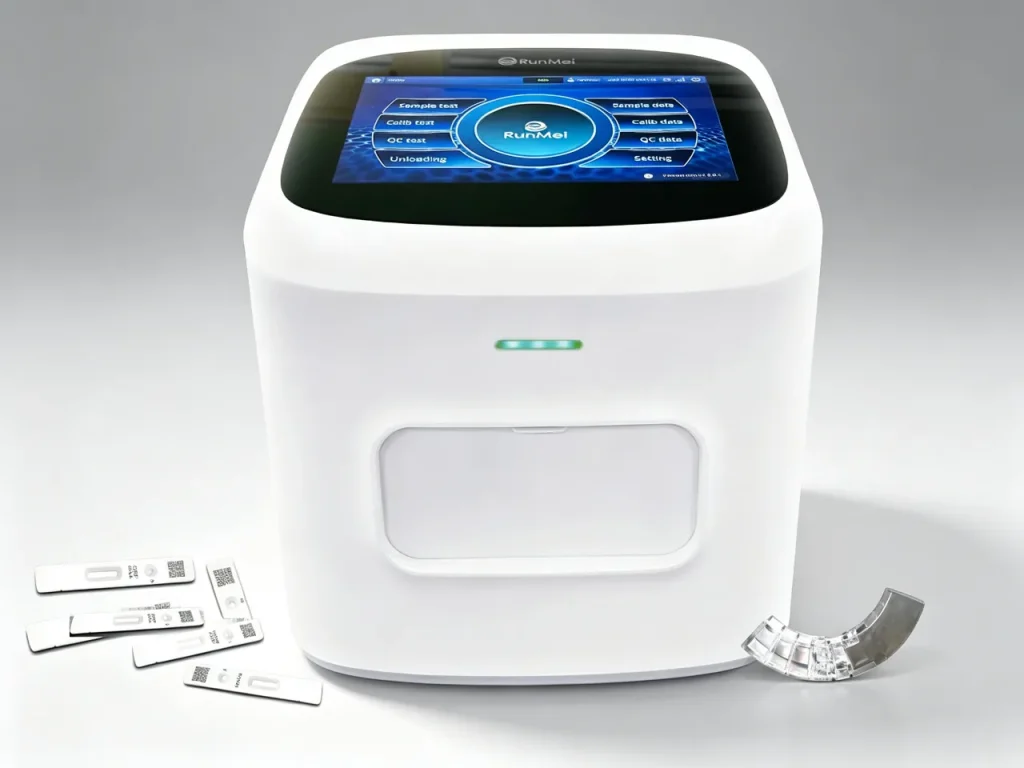
Figure: Hands-on practice on a hematology analyzer, with a supervisor watching the first runs, is what turns a training manual into a lasting skill.
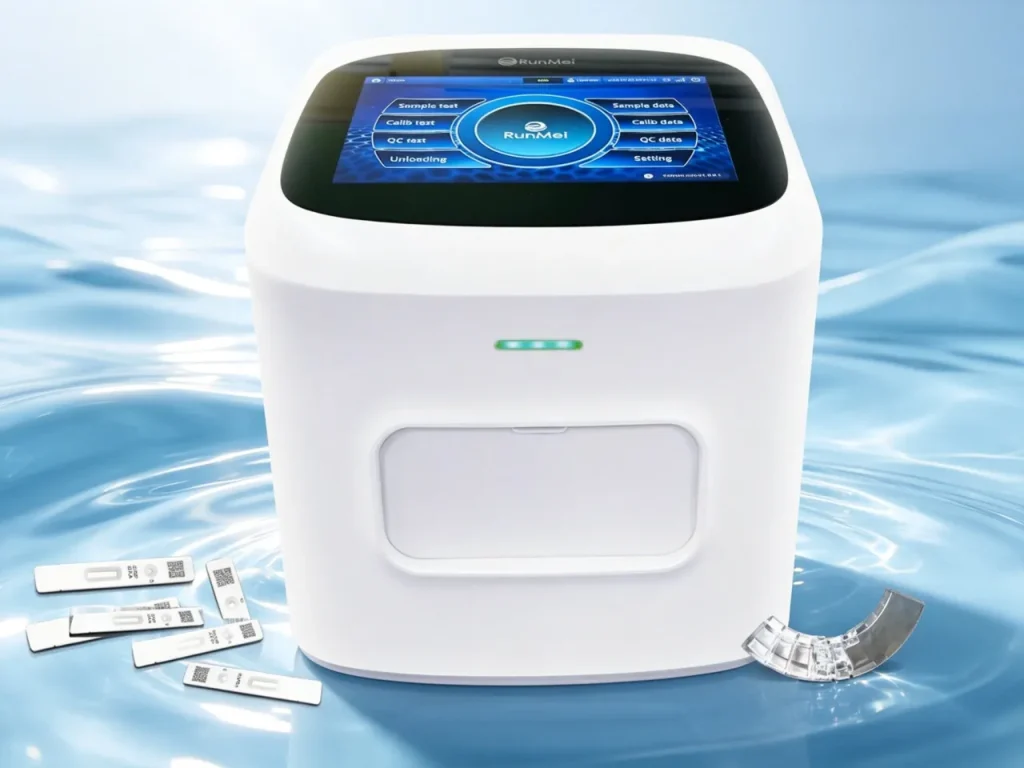
Figure: A portable blood analyzer with a guided on-screen workflow shortens training from weeks toward days and cuts handling errors to a minimum.
Medical Disclaimer
This article is for informational purposes only and does not constitute medical advice. Hematology analyzer operation and result interpretation must follow national regulations, professional supervision requirements and manufacturer instructions; training programs do not replace qualified clinical oversight of diagnostic testing. Device regulatory status varies by country; RUNMEI Health products are manufactured under ISO 13485, CE and FDA-aligned processes, but local registration requirements apply. Consult your national health authority before implementing task-shifting programs.