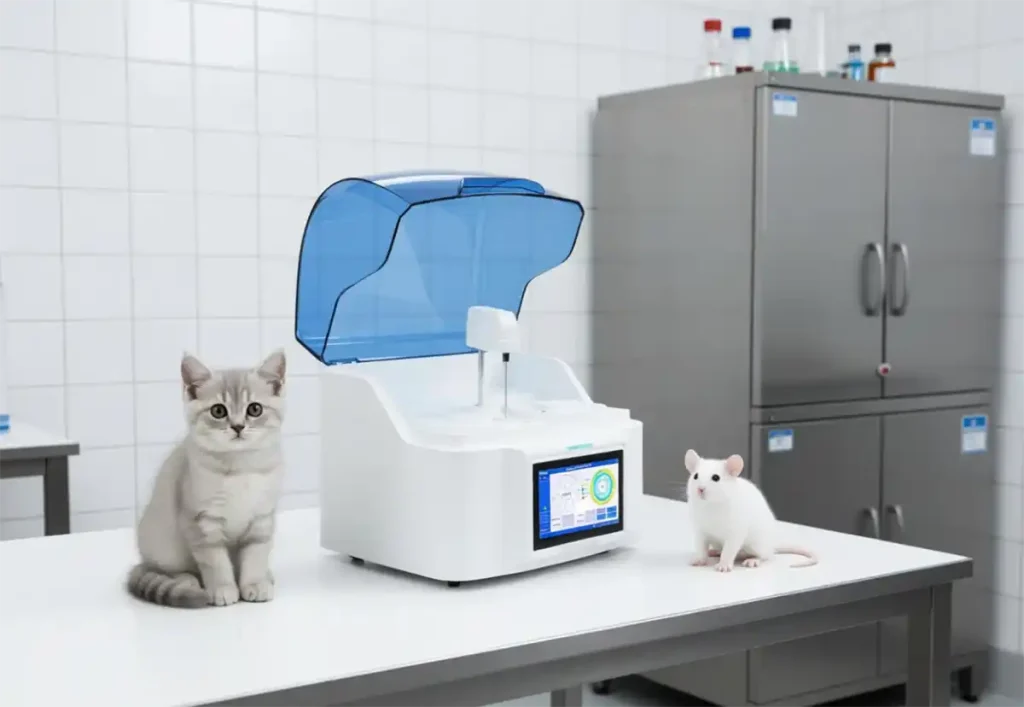
Space, staffing and electricity are tight in rural clinics. A compact hematology analyzer is designed around exactly those constraints.
By Dr. Daniel Weiss, PhD (Biomedical Engineer) | Reviewed by Dr. Sarah Thompson, PhD (Medical Diagnostics Researcher) | Published 2026-10-11 | Read time: ~7 minutes
You know the frustration. The clinic is small, the bench is crowded, the power flickers at midday, and still patients keep arriving with fever, pallor and stories of fatigue. For years the answer has been to send their blood away – which is how you ended up losing answers, and patients. A compact hematology analyzer for a rural clinic is designed around exactly these daily frustrations.
It is not a scaled-down city laboratory. It is a machine built to live in your room: small enough for a corner, simple enough for your existing nurse, forgiving of an unstable grid, and hungry for only a few drops of blood. This is a warm, practical look at how it actually fits into the working day you already have.
The short version: a compact analyzer fits a rural clinic workflow when it matches your bench space, your staffing, your power reality and your patient volume – not when it has the most features on a spec sheet.
The Space Problem: Your Bench Is Already Full
Rural clinics rarely have room to spare. The bench holds a microscope, a centrifuge, a stack of records and whatever arrived that morning. A compact hematology analyzer wants only a modest footprint – roughly the size of a small office printer – and needs light, ventilation and a stable surface more than it needs a dedicated room.
A Corner, Not a Department
The point is that you do not build a laboratory around the machine; the machine adapts to your corner. That is what changes the equation. Instead of dreaming of a reference lab you cannot staff, you get a capable instrument that slots beside the counter where you already draw blood.
Designing the Corner Around It
A little forethought makes the fit permanent. Leave clear space around the analyzer for the reagent compartment and a waste bin, keep it away from direct sun and the hand-washing sink, and place the sample draw area within arm’s reach. These small touches prevent the bench from slowly swallowing the device back into chaos, which is how so many good instruments end up unplugged under a cloth.
The Staffing Problem: Nobody Has Time for a Complex Machine
You do not have a full-time medical technologist, and that is fine. Modern compact systems walk operators through each step with on-screen prompts, use closed reagent packs and flag suspicious results for review. Your existing nurse, trained in a short program, can run a reliable CBC after a familiarization period.
Simple Does Not Mean Careless
Because the device handles counting automatically, the operator’s real job is good sampling, daily quality control and reading the flags. Understanding how differential blood analyzers work helps – the white-cell breakdown is what separates a common infection from something more worrying. Where budgets are tight, 3-part hematology analyzers for rural healthcare deliver the core count at lower cost, while 5-part models add finer white-cell detail.
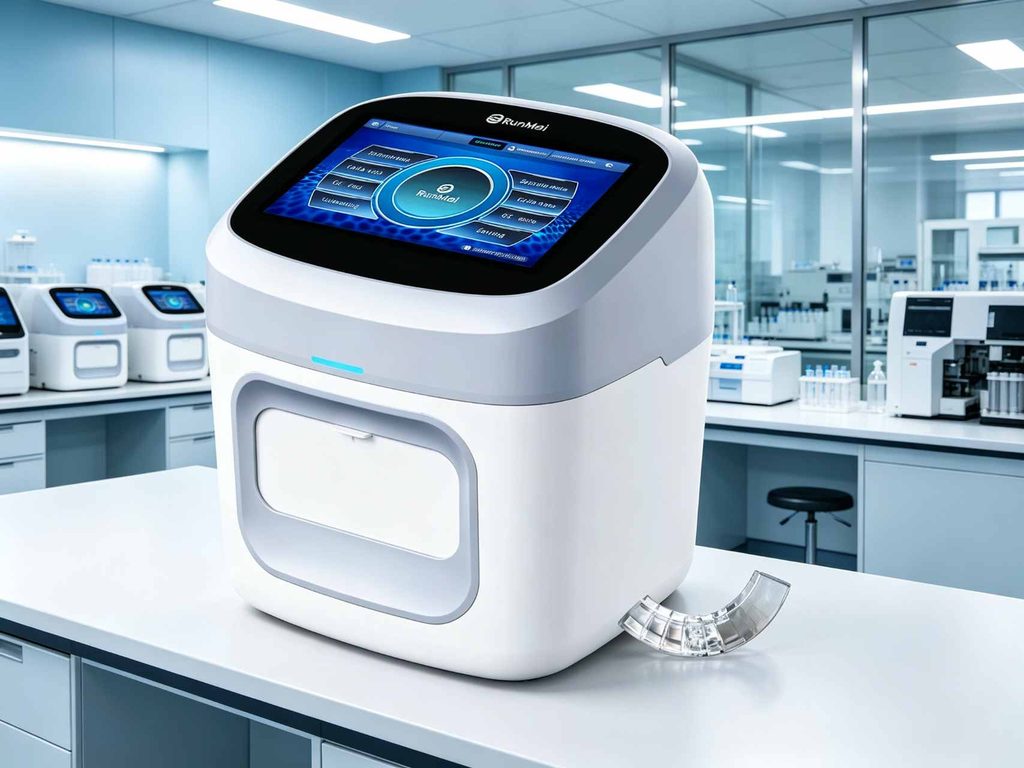
Figure 1: A compact benchtop hematology analyzer occupies a small footprint in a busy rural clinic corner.
Image title: Compact hematology analyzer fitting neatly on a rural clinic bench | Alt text (web): compact hematology analyzer for rural clinic workflow on a bench
Structured data: ImageObject schema for this image is provided in the Technical SEO & GEO Package below.
The Power and Reagent Problem: Small Volumes, Big Consequences
Volume in a village clinic is small and uneven. A big-city analyzer wastes reagents on idle cycles; a compact one is sized so a reagent pack matches your realistic monthly throughput and reduces expiry. It also draws little power, which matters when the grid drops out mid-morning.
Reagents That Survive Your Shelf
Ordering small quantities on a predictable schedule is the habit that keeps a rural analyzer alive. When a sample would otherwise sit waiting for transport – the familiar story of the blood sample that never arrives – on-site testing also removes the aging and clumping that degrade blood cells before they are ever counted.
Power That Does Not Need the Grid
Because compact analyzers draw modest current, many clinics run them through a simple battery backup or a small solar setup rather than depending on an erratic mains supply. Check the device’s idle and running consumption before you buy, and budget the battery that matches a long clinic day. A machine that restarts itself after every outage is far easier to live with than one that loses its calibration each time the lights flicker.

Figure 2: A portable multi-function analyzer slots into a small clinic’s existing bench and low-volume workflow.
Image title: Portable analyzer alongside everyday rural clinic equipment | Alt text (web): portable hematology analyzer for small rural clinic blood testing
Structured data: ImageObject schema for this image is provided in the Technical SEO & GEO Package below.
How Compact Analyzers Actually Fit the Day
Picture a normal morning. A mother brings a pale child; you draw, load, and within minutes you have hemoglobin and a count. An older man with diabetes comes for review; you trend his values rather than guess. A feverish farmer gets a platelet result that decides whether he stays or is referred.
Same-Visit Decisions
Speed changes behavior. When results are ready before the consultation ends, you treat now, adjust now, refer now. This is precisely the capability that global guidance expects at first-level care, reflected in the WHO Model List of Essential In Vitro Diagnostics, and the anemia burden it targets, summarized in WHO’s anaemia fact sheet, is concentrated exactly where these clinics operate.
Choosing the Right Fit Before You Buy
Fit is a procurement decision as much as a technical one. Match footprint to your bench, reagent pack size to your volume, power draw to your supply, and training to your team. In the United States, confirm device clearance through the FDA’s 510(k) premarket notification database and check CLIA complexity before you commit.
Start from the questions you actually answer most – anemia, fever triage, chronic monitoring. A useful starting point is the hematology analyzer buyer’s guide, which walks through these trade-offs. The right machine disappears into your workflow; the wrong one becomes another expensive ornament on an already crowded shelf.
Вопросы и ответы
How much space does a compact hematology analyzer need?
Most benchtop compact analyzers occupy roughly the footprint of a small office printer, needing only a stable surface, light and ventilation rather than a dedicated laboratory room. The exact footprint varies by model, so measure your available corner before purchase.
Can our existing nurse operate one without a lab degree?
Yes. Compact analyzers use guided on-screen steps, closed reagent packs and automatic counting, so trained clinic staff can run reliable CBCs. Structured training, daily quality control and clear rules for reviewing flags remain essential regardless of credential.
What about reagent expiry if we only test a few samples a day?
Choose a reagent pack size matched to your realistic monthly volume and order on a predictable schedule. Compact systems are designed for low throughput, which reduces both idle waste and the risk that reagents expire on the shelf between batches.
Does a compact analyzer give accurate results?
Modern compact analyzers are reproducible and adequate for screening and monitoring, and fresh on-site samples avoid transport degradation. For ambiguous results or complex cases, confirm against a reference laboratory; reviews such as the New England Journal of Medicine review of anemia of chronic disease show how serial counts guide judgment.
Conclusion
A compact hematology analyzer fits the rural clinic not by adding a new department, but by quietly joining the workflow you already run – sampling, deciding and treating all in one visit.
Respect the constraints that define your day – space, staff, power and volume – and the machine becomes invisible in the best way. Ignore them, and it becomes another burden. Buy for your corner, not for the showroom, and let it quietly earn its place beside the counter where care already happens.
Disclaimer
This article is provided for general informational and educational purposes only and does not constitute medical advice, diagnosis, or treatment. Laboratory testing must be performed by trained personnel in accordance with applicable regulations, manufacturer instructions and local law. Always consult a qualified healthcare professional for clinical decisions. Product names and capabilities described may vary by market and regulatory clearance. RunMei Health does not warrant that any device is suitable for a specific facility or jurisdiction without professional evaluation.