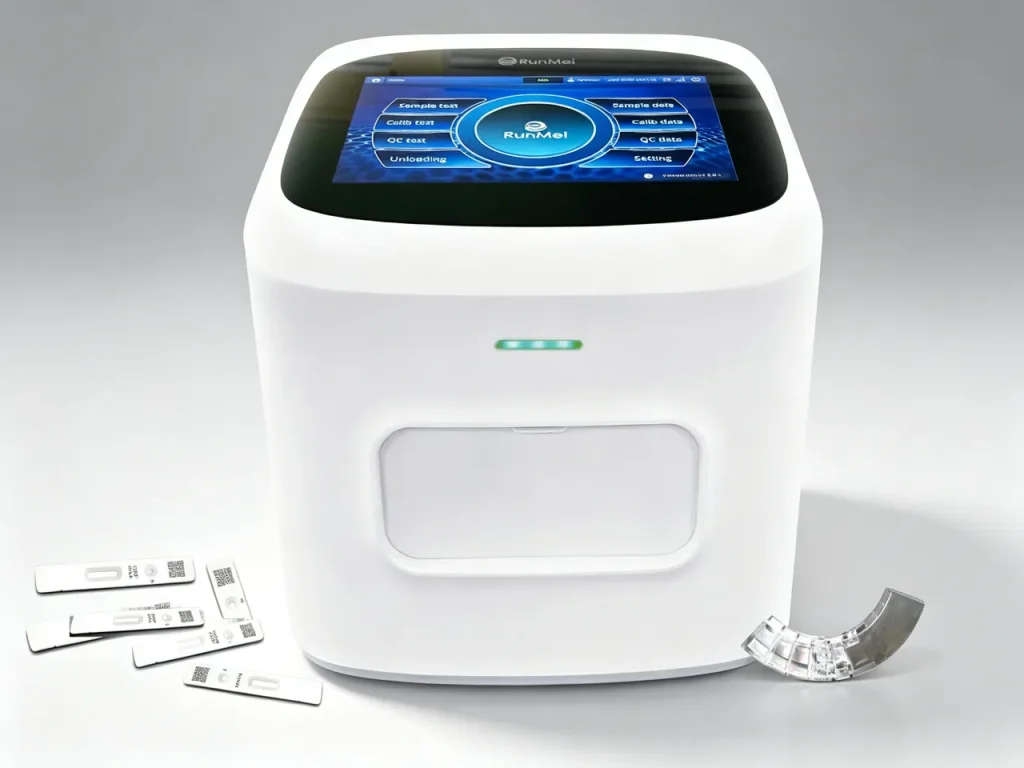
Picture a Saturday morning clinic packed with walk-ins and a technician hunched over a microscope counting cells by hand. That scene is fading fast, because a 3-part differential hematology analyzer now turns a complete blood count into a button press. For routine labs that mainly need WBC, lymphocytes, and granulocytes, this class of analyzer balances cost and capability better than almost anything on the bench.
What a 3-Part Differential Analyzer Actually Counts
A three-part hematology analyzer subdivides white blood cells into lymphocytes, mixed/mid cells, and granulocytes. That granularity is plenty for screening, preoperative checks, and chronic disease monitoring. According to industry guidance from the International Federation of Clinical Chemistry, roughly 70% of routine primary-care CBC requests do not require a full five-part breakdown.
Speed and Sample Footprint
Modern units process a sample in under three minutes using only 10–20 µL of capillary blood. That means a finger-prick, not a venipuncture, for most adult patients—a genuinely friendlier experience. runmeihealth.com catalogues compact analysers built around exactly this low-volume, quick-turn workflow for routine use across our site.
Why Not Always Buy a Five-Part Model?
The temptation is to spec upward—buy more parameters than you need. But five-part instruments cost 20–30% more, consume more reagent per test, and add maintenance complexity. For a lab whose case mix is routine, a three-part differential hematology analyzer from Brand A, Brand B, or Brand C covers your workflow at roughly $0.30 per test and demands far less operator retraining.
The Total Cost Trap
People forget the hidden bill behind bulky hospital equipment: annual service visits, calibration kits, and reagent wastage. Hematology analyzer systems with sealed reagent packs cut those recurring costs sharply. A colleague who switched from a legacy bench-top unit found their per-test reagent spend dropped by nearly 40%.
Actionable Buying Tip
Request a sample-count validation. Run 50 known specimens through the candidate device and compare against your reference lab—correlation should exceed 0.95 for WBC and hemoglobin. Only then compare price. Compact CBC machine vendors generally offer this demonstration free.
Key Takeaway
3-part differential covers ~70% of routine CBC needs.
Under 3-minute results from low capillary sample volumes.
Sealed reagent packs slash long-term ownership cost.
FAQ: When is a three-part differential not enough?
If your lab handles oncology cases, suspected parasitic infections, or requires basophil and eosinophil counts for specialist referrals, a five-part machine is worth the premium. Otherwise, three-part delivers the accuracy and throughput a routine lab needs at lower cost.
Ready to speed up your routine lab? Explore our blood analyzer solutions today.