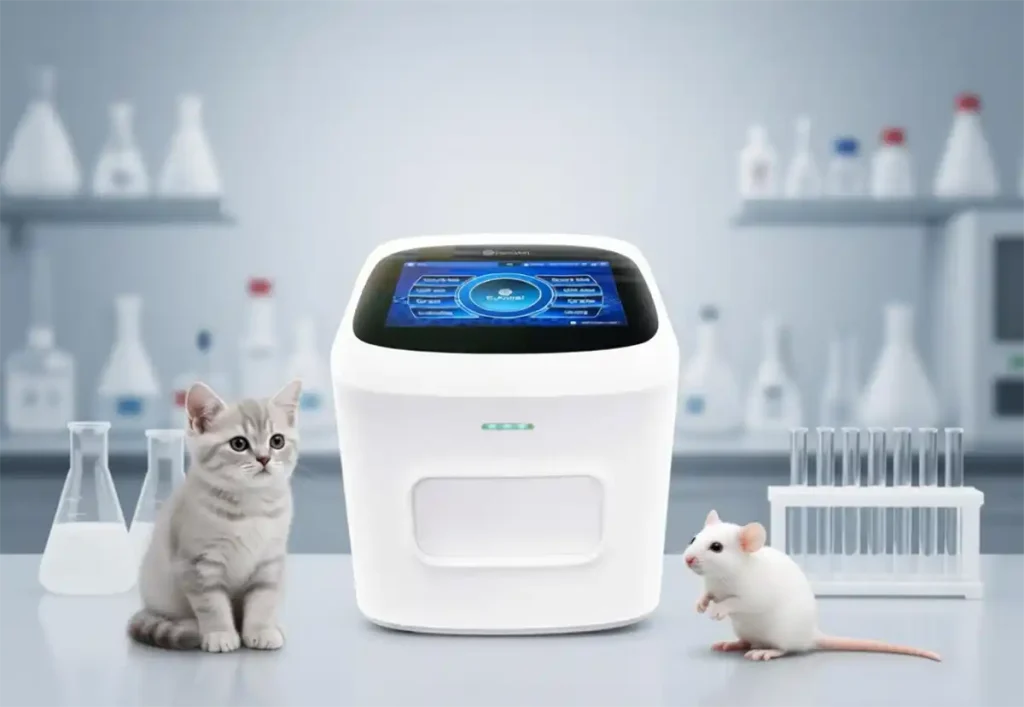
“Accurate complete blood counts are the foundation of evidence-based medicine,” observed the authors of a widely cited review of laboratory hematology in the veterinary literature. That principle, long accepted in human clinical pathology, has become a practical expectation in animal clinics as well, where turnaround time and operator throughput directly shape diagnostic decisions.
From Manual Enumeration to Automated Cytometry
Historically, the complete blood count (CBC) depended on manual hemocytometry and stained smears reviewed by trained technologists. Contemporary analyzers have replaced much of this work with impedance and optical measurement plus automated 5-part differential counts. A modern veterinary hematology analyzer now delivers white blood cell subset scattergrams, red cell indices, and platelet parameters within minutes of sample collection, aligning clinic workflow with the standards expected in referral laboratories.
Evidence and the Regulatory Baseline
Regulatory context matters for credibility. In the United States, in vitro diagnostic (IVD) devices are regulated by the Food and Drug Administration under Title 21 of the Code of Federal Regulations, while distributors serving European markets contend with the transition to the In Vitro Diagnostic Regulation (IVDR, (EU) 2017/746), which tightens conformity requirements over the legacy directive. Manufacturers that hold ISO 13485 certification and the CE mark provide an auditable quality baseline that purchasing committees increasingly take for granted.
Peer-reviewed accounts of veterinary hematology consistently note that sample quality and calibration discipline are the two largest controllable sources of error. This is precisely why instrument design should be interrogated: reagent dependence, cold-chain storage, and frequent calibration inflate the total cost of ownership and introduce failure modes that are hard to document in a quality manual.
The Case for a Reagent-Free Platform
Within the same price band, purchasing teams increasingly compare conventional reagent-based systems against no-liquid alternatives that employ AI cell imaging and micro-sampling optical counts. A mini biochemical analyzer paired in the same footprint extends a clinic beyond hematology into chemistry profiling, consolidating benches and training overhead. When procurement is constrained, benchmarking current hematology analyzer price expectations against total lifetime cost—reagents, waste, service, and downtime—is the more defensible comparison than sticker cost alone.
Selection Criteria Summary
For a laboratory evaluating a first-line or backup instrument, we recommend weighting four dimensions: analytic performance (5-part differential on venous and capillary samples), total cost of ownership (reagent-free and maintenance-light designs), regulatory standing (CE, ISO 13485, low starting quantities as low as a single unit), and support (24/7 availability). An established diagnostic analyzer supplier that offers regional distribution protection and multilingual interface options reduces procurement uncertainty for clinics operating across borders.
Automation does not remove clinical judgment, but it does make reproducible enumeration a realistic baseline for everyday practice. That is the threshold at which a veterinary clinic transforms from reacting to symptoms to monitoring physiology.