| Meta Title | Blood Analyzer Training and Maintenance for Remote Clinics |
| Meta Description | Remote clinics fear the broken analyzer and the untrained operator. Here is a practical field guide to blood analyzer training, QC, and maintenance. |
| URL Slug | /blood-analyzer-training-maintenance-rural/ |
| Focus Keyword | blood analyzer maintenance training |
| Secondary Keywords | hematology analyzer maintenance, blood analyzer training rural, lab equipment care remote clinic, analyzer troubleshooting |
| Publish Date | 2026-09-22 |
| Author | Dr. Elena Marsh, MD, MPH |
| Reviewer | Dr. James Okafor, PhD, FACB |
“Show me the two machines you fear most,” I asked the clinic manager during a site visit in rural Indonesia. She answered without hesitation: “The generator, and the analyzer.” The generator, because everything dies when it stops. The analyzer, because when it stops, no one in the district can fix it, and the nearest technician is a three-day round trip. That conversation is the real story of laboratory equipment in remote clinics: the fear is never the purchase, it is the upkeep. This field guide is the answer I give to every manager who asks — how to train staff so the machine is used correctly, run quality control so results are trusted, and maintain the instrument so the technician visit stays rare.
Why Rural Analyzers Fail: The Real Failure Modes
Equipment in remote clinics rarely fails the way it fails in a hospital laboratory. The dominant failure modes are mundane: a cleaning cycle skipped for a week, a reagent left unrefrigerated, a sample loaded incorrectly, a power fluctuation mid-run, a software update never installed. A survey of primary healthcare laboratory services in Tanzania found that even in laboratories that were working, more than half did not conduct internal quality control or participate in external quality assessment, and critical shortages of qualified laboratory personnel were concentrated in rural facilities. The pattern is consistent worldwide: the machine is usually fine; the support system around it is what collapses. Training and maintenance are therefore not accessories to the analyzer — they are the analyzer.
The Training Plan: From One Session to Permanent Competence
Level 1: Core Operator Training (Day One)
Every nurse who will touch the instrument needs one structured session covering: daily startup and priming, sample loading and identification, running controls, interpreting error flags, cleaning cycles, and shutdown. The training must be hands-on, not theoretical — the operator completes the full daily workflow twice under supervision. Modern touchscreen analyzers with guided workflows make this achievable in a single session, which is precisely their design intent: the FDA’s CLIA-waived framework defines tests that can be performed reliably by non-laboratory personnel, and automated analyzers are built to that standard.
Level 2: Quality Control and Troubleshooting (Week One)
By the end of the first week, the lead operator should run the daily control independently, log results, recognize out-of-range flags, and know the first three troubleshooting steps for each common alarm: clean the probe, check the reagent level, rerun the control. Troubleshooting is a teachable ladder, not a talent: every alarm has a defined response, written down and posted beside the instrument.
Level 3: Sustained Competence (Quarterly)
The competence that decays fastest is the competence that is never exercised. Quarterly refreshers — even a 30-minute session covering the alarm log and one practice run — keep the whole team current. Staff turnover is the hidden enemy of rural laboratories; the training system must survive the departure of the person who was trained first. Document procedures, name a backup operator, and cross-train deliberately.
Quality Control: The Discipline That Makes Results Defensible
A result from a rural analyzer is clinically useful only if it is trustworthy, and trustworthiness is manufactured daily by quality control. The minimum regime: a control run every morning before patient samples, a written log, and a defined response when controls fail (stop testing, investigate, rerun, document). External quality assessment — sending samples to a reference program periodically — closes the loop by catching problems internal controls miss. Programs like the WHO’s laboratory strengthening initiatives and national EQA schemes provide the framework; the blood analyzer’s onboard QC and flag systems enforce the routine discipline, and reliable point-of-care testing is also how underserved populations gain access to essential health services) under universal health coverage, where quality control is what keeps that access trustworthy. The analyzer upkeep guidance for modern instruments covers the specifics of auto-cleaning, calibration checks, and reagent management built into automated systems.
Maintenance: Designing for the Three-Day Technician
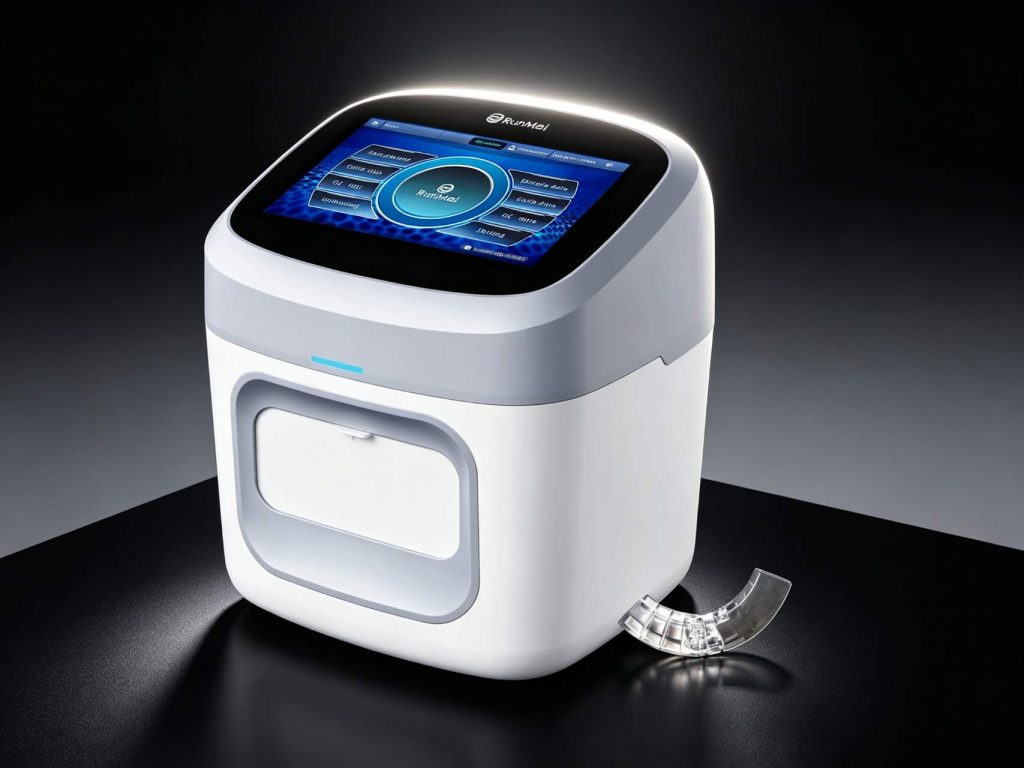
Figure: Structured operator training is what keeps a rural analyzer reliable month after month.
The best maintenance strategy is choosing equipment that minimizes the need for maintenance. Three design features matter more than anything else in remote settings:
1. Self-Cleaning Cycles
Instruments that flush, clean, and purge themselves between runs remove the single biggest cause of slow drift and clogged lines. A weekly deep-clean cycle replaces a scheduled service visit. The 5-part analyzer maintenance profiles on the market now emphasize automated cleaning as a core reliability feature rather than an extra.
2. Few Moving Parts and No-Liquid Systems
Pumps, valves, and fluid lines are the parts that wear and clog. Systems that minimize liquid handling — cartridge-based, microfluidic, or no-liquid architectures — structurally reduce failure rates. The mini analyzer with a no-liquid design is an example of the category moving toward zero-maintenance operation for small clinics.
3. Remote Diagnostics and Firmware
A machine that can phone home — transmitting error logs and receiving software fixes over the network — converts the three-day technician round trip into a 30-minute remote session. When selecting equipment, ask the vendor directly: what happens when the instrument alarms on Saturday? The answer tells you more about total cost of ownership than the brochure. Compact point-of-care analyzers designed for low-maintenance operation are worth prioritizing in remote settings for this reason.
The Preventive Maintenance Schedule Every Clinic Should Post

Figure: Instruments with self-cleaning cycles and few moving parts are built for settings where a technician visit takes weeks.
• Daily: startup, control run, log results, clean probe, shutdown properly.
• Weekly: full cleaning cycle, inspect reagent levels and expiry, review alarm log.
• Monthly: calibration verification, check consumables stock and storage temperature, tighten any service connections.
• Quarterly: deep clean, run an external quality assessment sample, refresher training.
• Annually: manufacturer preventive maintenance, or a documented self-inspection against the manual.
Building the Support System Around the Machine
Equipment reliability in a remote clinic is 20% the machine and 80% the system: trained operators, a posted procedure, stocked reagents, a named backup operator, and a service agreement with defined response times. When I visit clinics that have kept analyzers running for five years, the pattern is always the same — a laminated checklist on the wall, a control log with no gaps, and a staff member who can recite the first three troubleshooting steps for the top five alarms. None of that is expensive. All of it is non-negotiable. Recent evaluations of near-point-of-care diagnostics — documented in the New England Journal of Medicine — emphasize that minimal training requirements can expand access to timely diagnosis in peripheral health centers, and the same principle applies to the everyday CBC: the analyzer succeeds where the training and QC system succeeds.
أسئلة وأجوبة
- Q: How long does it take to train a nurse to run a blood analyzer?
A: Core operation — startup, samples, controls, cleaning — can be mastered in one structured hands-on session on modern automated analyzers. Sustained competence needs weekly practice and quarterly refreshers.
- Q: What is the most common cause of analyzer problems in rural clinics?
A: Skipped cleaning cycles, expired or poorly stored reagents, and gaps in daily quality control. These are support-system failures, not equipment failures, and they are preventable with posted procedures and a disciplined checklist.
- Q: Do rural clinics need external quality assessment?
A: Yes. Internal daily controls detect day-to-day drift, but external quality assessment — comparing results against a reference program — catches systematic problems that internal controls miss and is a core requirement of credible laboratory practice.
Disclaimer
This article is for general educational and informational purposes only and does not constitute medical advice, a product endorsement, or a guarantee of diagnostic performance. Maintenance schedules should follow the manufacturer’s instructions for the specific instrument. Laboratory equipment decisions should be made in consultation with qualified professionals, and all devices must be operated in accordance with the manufacturer’s instructions, local regulations, and applicable quality standards.
About the Author
Dr. Elena Marsh, MD, MPH is a board-certified clinical pathologist with 14 years of experience supporting primary care and rural health programs in North America, Africa, and Southeast Asia. She specializes in laboratory capacity building, point-of-care testing implementation, and diagnostic quality systems.
Reviewer
Dr. James Okafor, PhD, FACB is a clinical laboratory scientist and Fellow of the American College of Clinical Biochemistry, with 20 years of experience in laboratory quality assurance and regulatory compliance for in-vitro diagnostics.