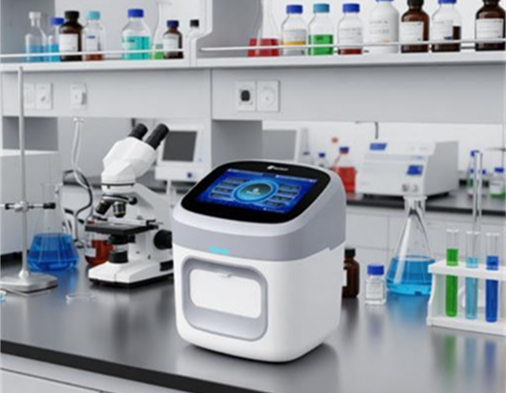
In this article, we define hematology analyzers, explain how they function, and outline their most common applications in health care.
Hematology analyzers have become indispensable tools in modern health care, transforming the way blood samples are analyzed and clinical insights are generated. These automated instruments rely on advanced detection technologies to provide comprehensive information about the cellular composition of blood, supporting the diagnosis and management of a wide range of hematologic disorders. Below, we explore what a hematology analyzer is, how it works, and where it is used in everyday clinical practice.
What is a hematology analyzer?
A hematology analyzer is a laboratory instrument designed to automate the analysis of blood samples, delivering detailed information about the cellular components present in the blood. These components include red blood cells (erythrocytes), white blood cells (leukocytes), and platelets (thrombocytes), each of which plays a critical role in maintaining health and homeostasis. By replacing manual counting and slide review, the analyzer improves both speed and reproducibility across routine and emergency testing.
How hematology analyzers work
Hematology analyzers combine several established technologies — impedance, flow cytometry, and optical methods — to characterize and quantify blood cells with remarkable precision. The process begins when a blood sample is introduced into the analyzer, either manually or through an automated sample-handling system. Inside the instrument, the sample passes through a series of steps that separate, count, and classify its cellular components:
- Electrical Impedance (Coulter Principle): measures the electrical resistance of blood cells as they pass through a narrow aperture, allowing the analyzer to determine cell size and count.
- Flow Cytometry: uses fluorescent dyes and laser beams to differentiate cell types based on their unique surface markers and physical properties.
- Optical Methods: apply light scattering and absorption to assess cell characteristics such as size, shape, and internal complexity.
The raw data generated by these methods is processed by sophisticated software algorithms that interpret the results and produce comprehensive reports for health care providers. Typical reports include a complete blood count (CBC), differential leukocyte count, red blood cell indices, and platelet parameters, giving clinicians a clear picture of the patient’s hematologic status.
Common applications in the medical field
Hematology analyzers are used across hospitals, clinics, laboratories, and research institutions. The most common applications include:
- Diagnostic testing: analyzers are essential for diagnosing and monitoring hematologic disorders such as anemia, leukemia, and thrombocytopenia. Rapid, accurate results allow providers to make timely decisions about patient care.
- Blood screening: blood banks and transfusion services use analyzers to screen donated blood for infectious diseases, including HIV, hepatitis, and syphilis, helping to prevent transfusion-related complications and ensure the safety of blood products.
- Treatment monitoring: for patients undergoing chemotherapy or other cancer treatments, analyzers track hematologic parameters over time so oncologists can assess treatment response and adjust regimens as needed.
- Research and development: analyzers support studies of blood cell biology, disease mechanisms, and therapeutic interventions, enabling high-throughput screening that accelerates discovery.
Types of hematology analyzers
- 3-Part Differential Analyzers: classify white blood cells into three categories — lymphocytes, monocytes, and granulocytes — and are well suited to small clinics and routine screening.
- 5-Part Differential Analyzers: provide a more detailed classification, separating neutrophils, lymphocytes, monocytes, eosinophils, and basophils for hospital and reference laboratory settings.
- Advanced Analyzers: add features such as reticulocyte counting, nucleated red blood cell detection, and integration with other laboratory systems.
Key parameters measured
Hematology analyzers report a wide set of clinically useful parameters, usually grouped as follows:
- Red Blood Cell (RBC) Parameters: RBC count, hemoglobin concentration, hematocrit, mean corpuscular volume (MCV), mean corpuscular hemoglobin (MCH), and red cell distribution width (RDW).
- White Blood Cell (WBC) Parameters: WBC count, differential count, and identification of abnormal cells.
- Platelet Parameters: platelet count, mean platelet volume (MPV), and platelet distribution width (PDW).
Together these parameters form the complete blood count, the most frequently ordered screening test in clinical practice and the foundation of hematologic assessment.
Choosing the right hematology analyzer
Selecting the most suitable hematology analyzer means weighing several factors that align with the clinical, operational, and financial goals of your health care setting. The right instrument improves workflow efficiency, supports diagnostic accuracy, and simplifies regulatory compliance. Consider the following:
1. Laboratory size and patient volume
Low-volume settings (physician offices, small clinics) often do well with a compact, benchtop analyzer that is cost-effective and easy to maintain. Mid- to high-volume laboratories (hospitals, diagnostic labs) usually benefit from a 5-part differential analyzer or a fully automated system with higher throughput and minimal operator intervention.
2. Required test parameters and clinical needs
Facilities that mainly perform routine CBCs need a simpler analyzer with standard RBC, WBC, and platelet parameters. Oncology, hematology-oncology, and research laboratories that require reticulocyte counts, nucleated RBC analysis, or detailed WBC subpopulations should choose a higher-end system with fluorescence or imaging-based detection.
3. Automation and workflow integration
Large laboratories may prefer integrated hematology workcells with pre-analytical sample handling, autoloaders, and post-analytical review systems that reduce manual error and improve traceability. Confirm that the analyzer integrates with your Laboratory Information System (LIS) for seamless reporting and faster turnaround, and look for models with remote access or cloud connectivity for easier troubleshooting and performance monitoring.
4. Ease of use and operator training
A touchscreen interface, intuitive software, and built-in help features shorten training time and build operator confidence. Systems with self-cleaning functions, low reagent consumption, and automated calibration reduce downtime and service costs. Choose vendors that offer onsite training, manuals, and remote assistance.
5. Regulatory compliance and quality standards
Ensure the analyzer complies with CLIA, CAP, FDA (510(k)), CE, or ISO standards appropriate to your region and accreditation requirements. Integrated quality-control tools and support for external quality assurance (EQA) programs help maintain ongoing accuracy and compliance — and a documented record of reliable results matters as much as the spec sheet.
6. Budget and total cost of ownership
Look beyond the purchase price to consumables (reagents and controls), maintenance contracts, and software licenses. Some analyzers are reagent-agnostic, giving you flexibility and potential savings over time. Evaluate reagent efficiency and how the instrument improves test volume, staff productivity, and diagnostic turnaround to justify its total cost of ownership.
7. Space and infrastructure requirements
Match the analyzer’s footprint to your available bench or floor space, and verify electrical requirements, ambient temperature tolerance, and waste-disposal procedures before installation.
Pro Tip: Always request a demonstration or trial period before purchase, and seek peer reviews or case studies from similarly sized institutions to benchmark performance and satisfaction.
Conclusion
Hematology analyzers are a cornerstone of modern hematology practice, offering unmatched capability for blood sample analysis and the diagnosis of hematologic disorders. Through their advanced technologies and wide-ranging applications, they continue to drive progress in patient care, research, and clinical practice.
Frequently asked questions
What does a hematology analyzer measure?
A hematology analyzer measures the cellular components of blood, typically reporting a complete blood count (CBC), a white blood cell differential, red blood cell indices (MCV, MCH, RDW), and platelet parameters (count, MPV, PDW).
What is the difference between a 3-part and a 5-part differential analyzer?
A 3-part differential analyzer classifies white blood cells into three categories (lymphocytes, monocytes, granulocytes), while a 5-part analyzer separates them into neutrophils, lymphocytes, monocytes, eosinophils, and basophils, providing more detail for hospital and reference laboratory settings.
How long does a complete blood count take on a modern analyzer?
Modern automated hematology analyzers can return a complete blood count within minutes, which is one reason they are widely used in point-of-care and emergency settings where fast clinical decisions matter.
How do I choose between a compact analyzer and a high-throughput system?
Match the instrument to your laboratory’s sample volume, required test parameters, workflow, budget, and total cost of ownership. Low-volume clinics may prefer a compact benchtop analyzer, while mid- to high-volume laboratories usually benefit from a fully automated 5-part system with higher throughput.