| Meta Title | How to Choose a Blood Analyzer for a Rural Clinic |
| Meta Description | Choosing a blood analyzer is about patient volume, reagents, and training — not specs. Compare 3-part vs 5-part, portability, and per-test cost for rural clinics. |
| URL Slug | /how-to-choose-blood-analyzer-rural-clinic/ |
| Focus Keyword | how to choose blood analyzer |
| Secondary Keywords | 3 part vs 5 part differential, portable hematology analyzer, blood analyzer buying guide, hematology analyzer for small clinic |
| Publish Date | 2026-09-22 |
| Author | Dr. Elena Marsh, MD, MPH |
| Reviewer | Dr. James Okafor, PhD, FACB |
Everyone thinks choosing a blood analyzer begins with accuracy — the correlation coefficients, the precision studies, the coefficient of variation at low counts. It does not. Choosing an analyzer for a rural clinic begins with three humbler questions: How many patients will you test a day? Who will run the machine? And what will each test cost five years from now? Accuracy, in any modern instrument worth buying, is largely a solved problem — the FDA and other regulators set performance floors that all legitimate devices clear. The decision that actually determines whether the analyzer succeeds in a rural clinic is fit: fit with patient volume, fit with staff skills, fit with the reagent budget, and fit with the physical realities of a small facility. Get the fit right, and the machine will be used, controlled, and loved. Get it wrong, and the most accurate analyzer in the world will sit under a dust cover.
Step 1: Define Your Testing Volume Honestly
Everything downstream depends on this number, and clinics almost always overestimate it. Count actual blood test orders from your last three months — not your aspirations. The volume bands look roughly like this:
• Under 15 tests/day: a portable, cartridge-based or low-throughput instrument makes sense; throughput is irrelevant, simplicity is everything.
• 15–60 tests/day: a compact automated analyzer with 60–80 tests/hour capacity and automatic cleaning fits comfortably, with headroom for growth.
• Over 60 tests/day: consider higher-throughput models, continuous loading, and dual instruments for redundancy.
The discipline matters because it decides the reagent economics: a machine sized for 200 tests a day burns reagents and controls for the 20 you actually run. Per-test cost — the number that runs for the life of the instrument — is set by volume as much as by price.
Step 2: 3-Part vs 5-Part Differential — A Decision, Not a Spec

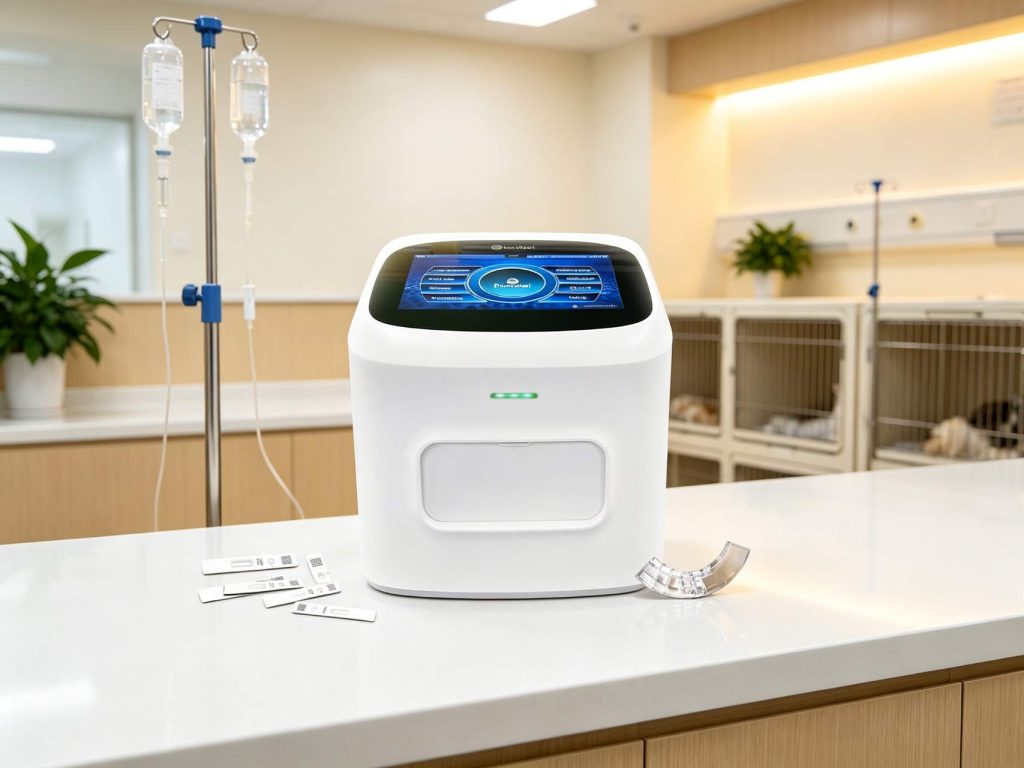
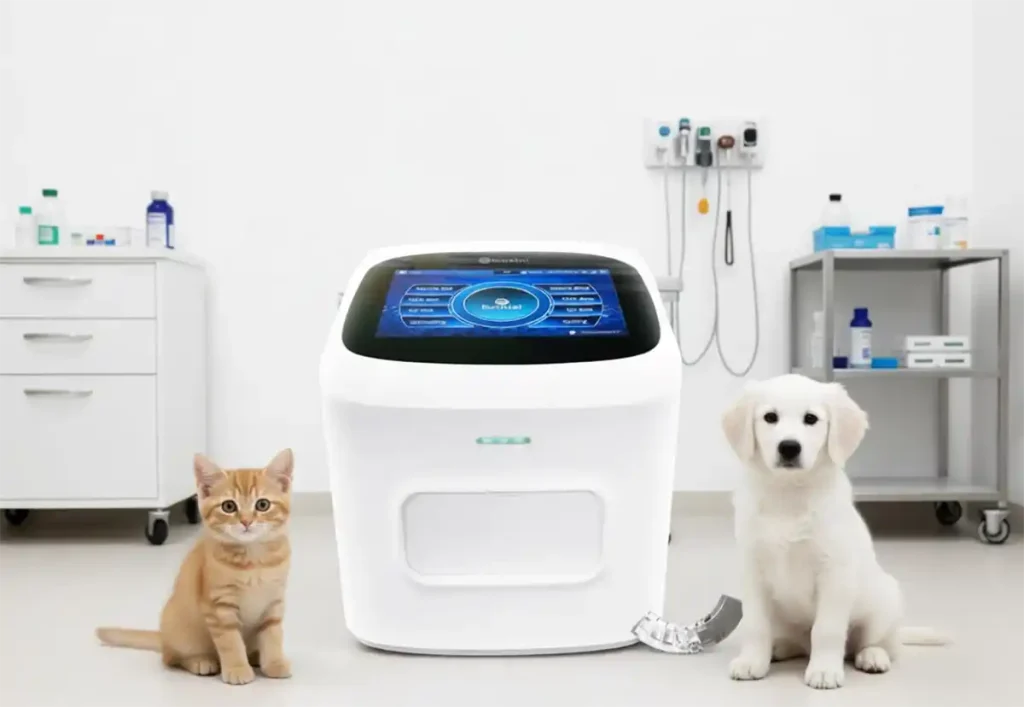
Figure: The right analyzer for a rural clinic is the one that matches its patient volume, staff, and reagent budget.
The 3-part versus 5-part differential question is the fork in the road for every rural buyer, and it deserves a decision framework, not a spec sheet. A 3-part analyzer classifies white cells into lymphocytes, monocytes, and granulocytes — sufficient for routine screening, infection flags, and anemia work in low-risk populations. A 5-part analyzer separates neutrophils, lymphocytes, monocytes, eosinophils, and basophils — adding eosinophil counts for parasite and allergy work, basophil flags for myeloproliferative concerns, and the clinical granularity that referral decisions increasingly expect.
When a 3-Part Analyzer Is Enough
Routine screening, general outpatient care, and low-risk adult populations are served well by a 3-part analyzer.
When a 5-Part Analyzer Pays Off
Substantial pediatric fever, parasite, allergy, or hematology-follow-up populations benefit from the eosinophil and basophil detail a 5-part instrument adds.
The full trade-off — including reagent costs and the use-case matrix — is covered in the dedicated 3-part vs 5-part blood analyzer differential guide. Whichever you choose, verify the parameters you actually need: a bare minimum menu of WBC, RBC, hemoglobin, hematocrit, platelets, and the differential classes.
Step 3: Portability and Sample Volume Decide Where Testing Happens
Rural medicine is a mobile discipline: outreach clinics, school screening days, antenatal camps, and village health posts. If any part of your testing happens outside the main laboratory room, portability changes the answer. Compact analyzers that fit a table corner, run on standard power, and tolerate transport can move with the program; fixed benchtop systems cannot. Sample volume matters in the same way: instruments that run 10–20 µL of whole blood or prediluted samples make testing viable for children, the frail, and field conditions where venous draws are impractical. A portable multi-function analyzer that works from a fingerstick into a sealed cartridge is the modern answer to the “clinic-without-a-phlebotomist” problem.
Step 4: Reagent and Maintenance Economics
Ask three questions of every vendor, and write the answers in the same currency:
1. Cost per test including reagents, controls, and consumables — compare at your real volume, not the brochure’s.
2. Reagent efficiency — tests per liter of diluent, open versus closed channel, and the price volatility of the consumables.
3. Maintenance burden — self-cleaning cycles, moving parts, and what a service visit really costs and takes (days, not hours, in rural areas).
على head-to-head analyzer comparisons published by manufacturers are useful starting points precisely because they force vendors onto the same scorecard — precision, carryover, sample volume, and reagent economics in one table. Read them with the three columns above in mind, and discount any comparison that omits per-test cost.
Step 5: Training, Quality Control, and Regulatory Fit
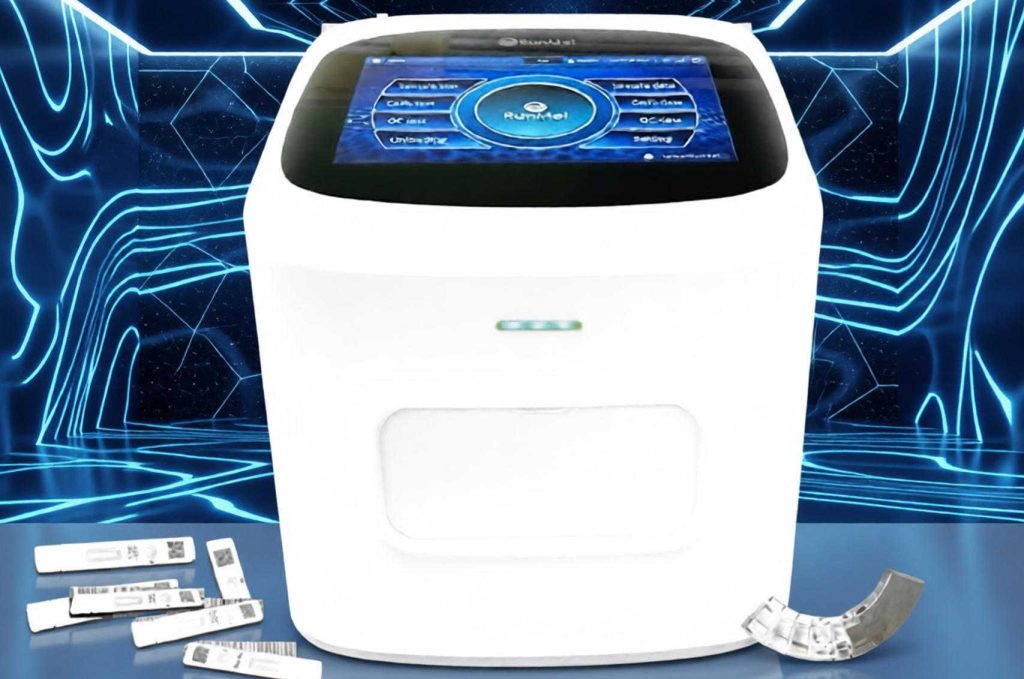
Figure: Portability and low sample volume widen the range of settings where an analyzer can live.
A rural clinic usually has no laboratory scientist on staff. The analyzer must therefore be operable by a nurse after one training session: touchscreen workflow, guided steps, minimal manual pipetting, and automatic cleaning. Equally important is the quality-control regime — daily controls, documented runs, and an instrument that makes compliance easy rather than burdensome. In the United States, the FDA’s CLIA-waived test framework is the reference for tests that can be performed reliably by non-laboratory personnel; if your clinic operates under CLIA, waivable workflow is a decisive advantage. Internationally, verify CE marking or local registration with your market’s requirements before purchase — the same regulatory logic that lets near-point-of-care diagnostics expand access in peripheral health centers, documented in the New England Journal of Medicine, applies to everyday hematology instruments.
Step 6: Buy Through the Channel That Supports You
Rural buyers are vulnerable in the purchasing process: the distributor who disappears after the sale, the spare part that takes six weeks, the reagent contract that quietly escalates. Two structural choices reduce that risk. First, buy manufacturer-direct where possible — manufacturers have the strongest incentive to keep instruments running and usually offer better reagent pricing than intermediaries. Second, put the support terms in writing: response times, spare-part commitments, and training included.
A Seven-Point Decision Scorecard
1. Volume reality (tests/day) — ✔ 2. Menu (parameters + differential class) — ✔ 3. Sample volume — ✔ 4. Portability need — ✔ 5. Per-test reagent cost at your volume — ✔ 6. Training burden — ✔ 7. Support terms — ✔
Score the instruments against the scorecard, not against each other’s brochures. The analyzer that wins is the one that scores on *your* row — and that is the entire art of choosing a blood analyzer for a rural clinic. The WHO’s global data on anemia — **40% of children aged 6–59 months and 37% of pregnant women affected** — is a reminder of the burden your new instrument will confront as it goes into routine service.
أسئلة وأجوبة
- Q: Is a 3-part or 5-part blood analyzer better for a rural clinic?
A: It depends on your case mix. A 3-part analyzer covers routine screening, infection flags, and anemia work at the lowest cost; a 5-part analyzer adds eosinophil and basophil detail valuable for pediatric, parasite, allergy, and hematology-follow-up populations.
- Q: What is the most important spec when buying a blood analyzer for a small clinic?
A: Fit with your real testing volume and reagent budget. Per-test reagent cost, not purchase price, dominates the lifetime cost, and a machine sized for your actual volume keeps controls and reagents economical.
- Q: Can one nurse run a hematology analyzer reliably?
A: Yes. Modern analyzers use automated, touchscreen workflows and many are CLIA-waived, meaning they can be operated reliably by non-laboratory staff after structured training, with daily quality control.
Disclaimer
This article is for general educational and informational purposes only and does not constitute medical advice, a product endorsement, or a guarantee of diagnostic performance. Purchasing decisions should be based on verified current specifications, quotations, and local regulatory requirements. Laboratory equipment decisions should be made in consultation with qualified professionals, and all devices must be operated in accordance with the manufacturer’s instructions and applicable quality standards.
About the Author
Dr. Elena Marsh, MD, MPH is a board-certified clinical pathologist with 14 years of experience supporting primary care and rural health programs in North America, Africa, and Southeast Asia. She specializes in laboratory capacity building, point-of-care testing implementation, and diagnostic quality systems.
Reviewer
Dr. James Okafor, PhD, FACB is a clinical laboratory scientist and Fellow of the American College of Clinical Biochemistry, with 20 years of experience in laboratory quality assurance and regulatory compliance for in-vitro diagnostics.