Here is a number that should stop you cold: for a moderately busy lab running a CBC on a wet-reagent platform, the consumable and reagent line can exceed the analyser’s purchase price within the first two years — before you count a single hour of maintenance labour.
Let’s put the data in context. Within haematology, the complete blood count is the world’s most-ordered lab test — hundreds of millions run annually. The list price of conventional analysers from Brand A and Brand B is only the visible iceberg; beneath it sit the recurring diluents, lysing agents, sheath fluids, calibrators, and cold-chain storage that compound with every shift. The WHO and public-health literature have long centred supply-chain fragility as a core barrier to reliable diagnostics in low-resource settings — a problem most visible when wet reagents fail to arrive or spoil in heat. And in the United States, the FDA regulates in-vitro diagnostics as medical devices under 21 CFR, a reminder that a cheap lab result is worthless if the instrument’s evidence base doesn’t justify it.
The cost-per-test equation
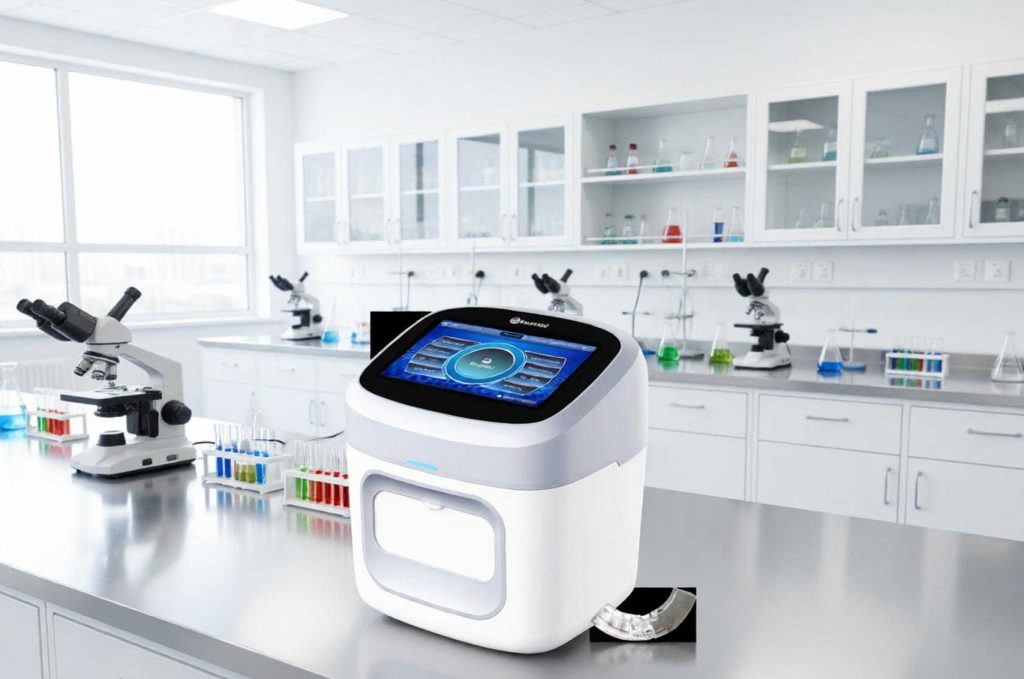
The economic case for the No-Liquid System is a simple ratio. A dry-imaging analyser reads cells directly and classifies them with AI — no sheath fluid, no lysing agent, no reagent flow path. With per-test reagent cost pushed toward zero, the equation rebalances dramatically. Add the maintenance side: fewer moving parts and no wet lines mean markedly less downtime, less calibration burden, and no hazardous waste stream. For labs monitoring sepsis-suspect patients, this also compresses turnaround time — the faster the 5-part differential, the sooner empiric therapy is refined. A portable point-of-care analyzer with real throughput makes that speed available at the bedside, not just in the core lab.
Portfolio effects for human and vet labs
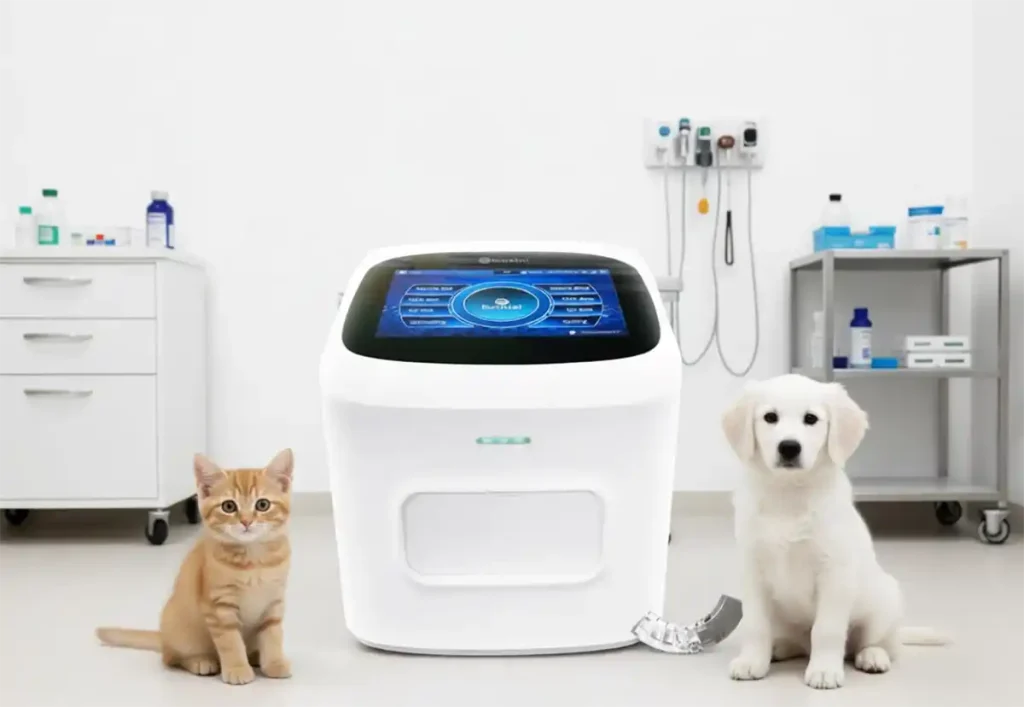
Beyond a single instrument, the numbers favour consolidation. Pairing a dry-imaging blood cell counter with a compact clinical chemistry system lets one bench deliver haematology and biochemistry — fewer machines, wider menus, lower footprint cost. For veterinary practices, the same reasoning supports broad-species coverage: an animal hematology analyzer that handles multiple species without swapping reagent kits, avoiding the fixed single-species cost lock-in. For the chemistry half of the bench, a clinical biochemistry analyzer completes the picture on the same footprint.
The procurement variable
Finally, weigh uncertainty costs, which are real but rarely on any spreadsheet. Customs clearance, certification doubt, and single-vendor lock-in each carry a risk premium. A CE-marked, ISO 13485-certified dry analyser with a low minimum order quantity — from a single unit — plus regional protection and 24/7 support, turns that uncertainty into a controlled, low-risk pilot. The data across every line — reagent cost, uptime, turnaround, procurement risk — points the same direction. Labs that run the three-year model against their own volumes consistently find the dry, imaging-based generation of haematology analysers is not a niche choice, but the statistically rational one.