Meta Title: Blood Analyzer for Rural Clinics: On-Site CBC Testing Guide | RunMei
Meta Description: Why rural clinics need a blood analyzer: how on-site CBC testing replaces multi-day referrals with same-day results, anemia and fever answers in one device.
By Dr. Elena Marchetti · MD, MPH, Rural Health Diagnostics | Reviewed by Prof. Daniel Mwangi (PhD, MSc, Laboratory Systems Advisor) | Published: 2026-09-24
The patient had travelled three hours to the district hospital for a test her village clinic could not run. The practical questions around blood analyzer — which machine, how much per test, how fast a result arrives — are the subject of this article. Two days later, the result came back normal. The journey, the lost wages, the overnight stay — all of it for a number the clinic could have produced in ten minutes with the right instrument on the bench. The محلل أمراض الدم catalog covers the instruments rural programs order most often.
The pages that follow cover what the sales brochure does not: what blood analyzer can and cannot deliver in Rural Clinics Need, what it costs to run rather than to buy, and the mistakes that turn useful instruments into idle furniture. About 3 billion people worldwide still cannot reach a health facility within one hour on foot, a figure the WHO has used to argue for diagnostics that travel to patients instead of the other way around. The aim is to give clinic managers and program planners a field-tested basis for decisions, not a list of product claims. WHO . Facilities weighing the options can browse the portable blood analyzer range to compare configurations side by side.
Key Takeaways
- On-site CBC testing removes the multi-day referral cycle that delays diagnosis in rural areas.
- A single blood analyzer can cover anemia, infection, malaria and fever triage in one device.
- Total operating cost, not purchase price, determines whether a rural clinic keeps the machine running.
- Operator training and simple quality checks matter more than brand for sustained accuracy.
What a Rural Clinic Loses When Testing Happens Elsewhere
Referral-based testing looks reasonable on paper and fails quietly in practice. Blood tubes travel on buses, sit in waiting baskets at the district lab, and occasionally arrive back hemolyzed or mislabeled. The World Health Organization has repeatedly emphasized that the distance between a patient and a functioning laboratory is itself a health risk: when the nearest lab is a day away, clinicians treat without data or do not treat at all.
The losses are measurable. A delayed hemoglobin result postpones an iron prescription by days. A delayed white cell count lets a treatable bacterial infection turn into a referral that the family cannot afford. Clinics that bring the test closer to the patient do not just save travel time; they change which patients actually get a diagnosis.
the blood analyzer is the seed; the program is the tree. Training, supervision, registers, quality checks and a supply line that outlasts the donor — these are what turn a machine into a service that keeps running. Programs that design for sustainability from the first installation meeting are the ones still running at the five-year review. FDA . Programs that want a deeper differential can read the 5-part differential blood analyzer page for the trade-offs.
The Three-Hour Test That Costs Three Days
Consider the arithmetic of the referral path: travel, registration, sample collection, transport, analysis, result retrieval, and a return visit. Even in the best case, the round trip consumes two to five days. On-site testing collapses that pathway to a single consultation. That is the entire value proposition of the on-site blood count, and it is why ministries are rethinking the rule that says testing belongs only in district laboratories.
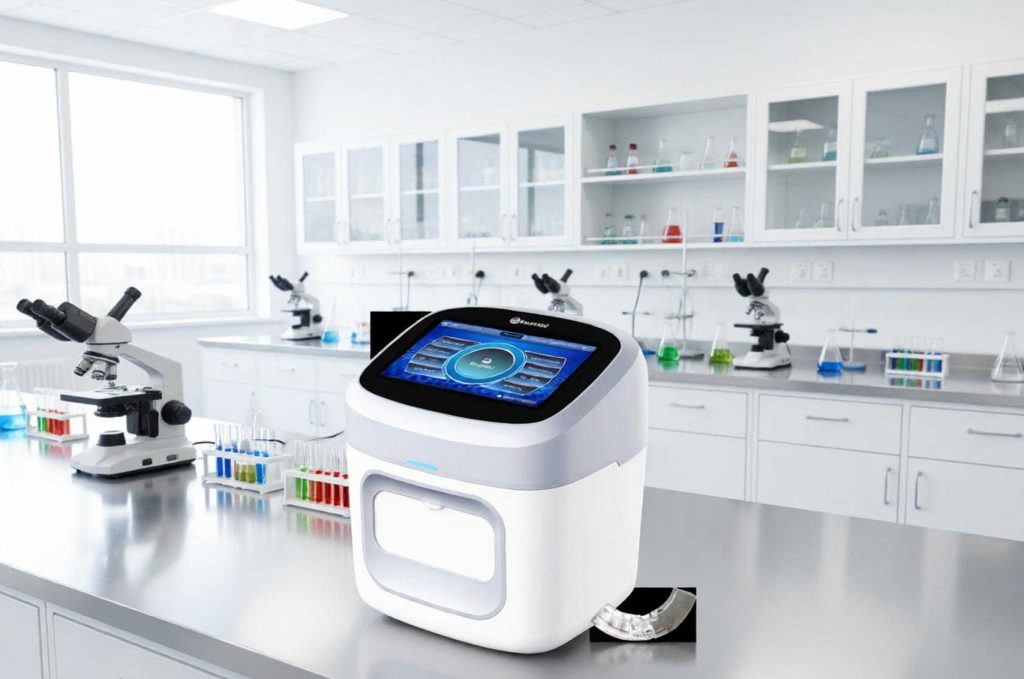
Fig. 1 — RunMei automatic hematology analyzer in a rural clinic setting. Portable blood analyzer on the bench of a rural clinic. | Alt: portable blood analyzer on the bench of a rural clinic
One Instrument, Many Answers: What the CBC Actually Covers
A complete blood count (CBC) is the single most requested laboratory test in primary care, and for good reason. It answers a surprising share of the questions a rural clinician faces every day: Is she anemic? Is there a bacterial infection? Is the fever more likely malaria, dengue or sepsis? Is the platelet count safe for surgery or delivery?
Modern hematology analyzers deliver these answers from a single small sample, usually within minutes. Devices designed for point-of-care use add practical requirements that hospital instruments do not: battery tolerance, compact footprint, simplified maintenance, and reagent systems that do not demand a cold chain.
Power is the silent partner in every rural deployment. In Rural Clinics Need, outages are not the exception; they are the schedule. The practical answer is a blood analyzer that tolerates the interruption — battery capability that finishes the test in progress, a startup that does not lose calibration, and a surge protector between the wall and the machine. Programs that budget for power, not just for the instrument, are the programs whose instruments stay alive. Budget teams should see the open-channel blood analyzer cost analysis before signing off on procurement.
Microsample Volume Matters in Real Clinics
A rural clinic does not have a pediatric phlebotomy team. The machines that survive rural use accept very small samples — often under 20 microliters — which makes testing possible for infants, malnourished children and elderly patients whose veins are hard to find. Microsample design is not a luxury feature; it is a daily-use requirement.
Making the Case to a Budget Committee
The purchase price of a blood analyzer is only the first line of the real calculation. Procurement committees that look no further often choose a machine the clinic cannot afford to run: proprietary reagents, expensive service contracts, consumables that must be imported. The total cost of ownership — reagent cost per test, maintenance, training, downtime — is what determines whether the device is still running in year three.
Open-channel reagent systems change this arithmetic by letting facilities source reagents competitively rather than paying a single manufacturer’s premium. For a facility running a few hundred tests a month, the difference between open and closed channels can be a 40 to 50 percent reduction in the single largest recurring cost.
The numbers have to close in the real world. Volume assumptions, fee structures, reagent costs and the hidden cost of the journey patients would otherwise make — each belongs in the model before the purchase, not after. Facilities that run the arithmetic honestly find the blood analyzer is not an expense; it is the cheaper way to do what they were already doing.
What to Ask Before Signing
Ask the supplier four questions: What does the reagent cost per test? What happens when power fails mid-run? Who trains the operators and how often? And what is the realistic downtime if the instrument needs service? The answers separate a device designed for the real clinic from a device designed for the brochure.
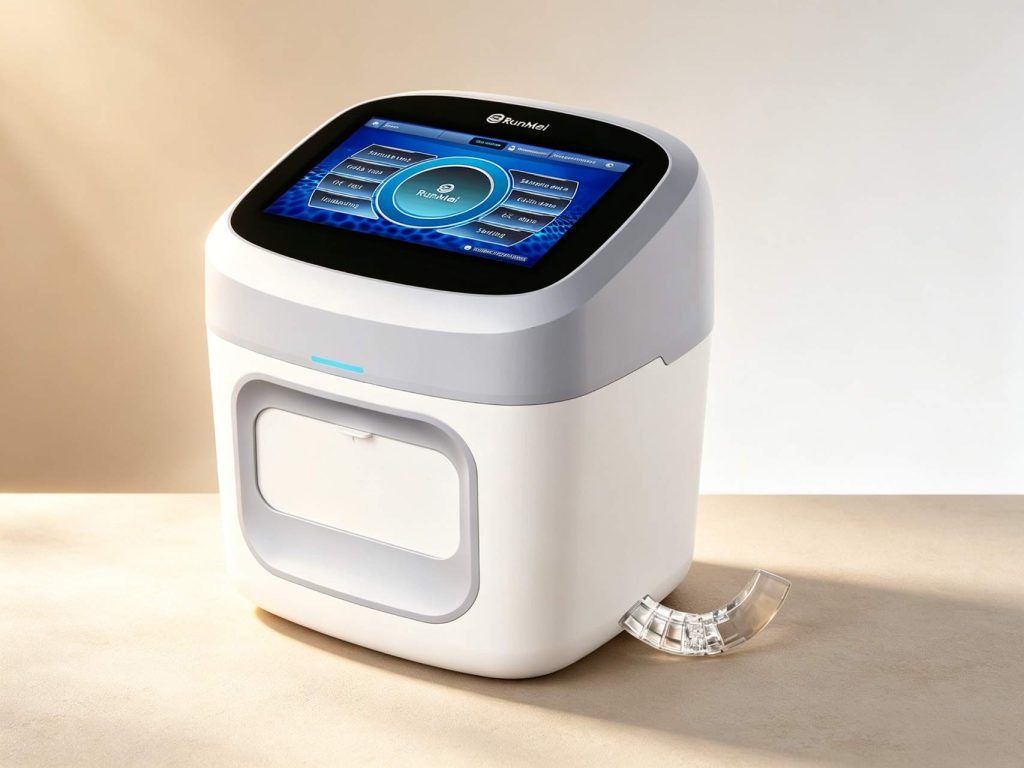
Fig. 2 — RunMei low reagent cost blood analyzer during routine testing. Rural clinic blood analyzer cbc testing in progress. | Alt: rural clinic blood analyzer CBC testing in progress
The First 90 Days
The first quarter after installation is the period that separates a successful deployment from a stalled one. Early problems are normal — an unfamiliar workflow, a supply hiccup, a control result that will not settle — and the difference is how quickly they are caught. A facility that schedules its own 90-day review, with the register open and the errors on the table, fixes its problems while they are still cheap to fix.
Reading the Register Honestly
The register is the review’s raw material: tests run, results flagged, referrals made, problems logged. The facility that reads it without defensiveness learns what its training missed and its supply line forgot. The facility that skips the reading repeats the first quarter’s mistakes for the rest of the year.
The Second-Quarter Targets
By day 120, the targets should be visible: tests on a predictable weekly schedule, controls passing consistently, one operator certified per shift, and a referral pattern that matches the protocol. Facilities that set these four targets at installation find the second quarter runs itself.
For teams accountable for on-site CBC testing, the practical effect shows up within the first month. Decisions about rural primary care diagnostics are usually made at district level — and the register feeds them. It also strengthens same-day blood count, a benefit that rarely appears in the budget line.
الأسئلة المتداولة
Q1. Can a nurse without laboratory training operate a blood analyzer?
Yes. Point-of-care analyzers are designed for operators with basic training, and CLIA-waived devices in the United States are explicitly approved for use outside the traditional laboratory. A short structured training program plus a simple daily quality check is enough for most rural facilities.
Q2. How much does a CBC cost per test with an open-channel analyzer?
With open-channel reagent systems, the consumable cost per CBC can fall well below the cost of closed systems, often by 40 to 50 percent. The exact figure depends on volume, reagent sourcing and whether controls are included in the calculation.
Q3. What sample volume does a rural-friendly analyzer need?
Most point-of-care hematology analyzers need only a few microliters of blood — commonly 10 to 20 microliters — which makes testing practical for infants, small children and difficult draws.
Q4. What happens when the power goes out mid-test?
Analyzers designed for off-grid settings include battery backup or tolerate brief interruptions without losing calibration. Facilities in areas with unstable power should also budget for a simple surge protector and a UPS.
Sources & References
- World Health Organization data show that in lower-income countries a large share of the rural population still lives beyond the reach of a functioning laboratory; the WHO recommends primary care facilities be reachable within roughly 5 km, yet global estimates indicate about 3 billion people cannot reach a health facility within one hour on foot. Source: WHO — https://www.who.int/news-room/fact-sheets/detail/primary-health-care
- The U.S. Food and Drug Administration (FDA) grants CLIA waiver to certain automated hematology analyzers, allowing them to be operated outside the traditional laboratory by staff without advanced training; dual 510(k) and CLIA waiver submissions are documented under the Medical Device User Fee Amendments. Source: FDA — https://www.fda.gov/medical-devices/ivd-regulatory-assistance/clia-waivers
- Reviews published in the New England Journal of Medicine have repeatedly underlined that the single most reliable way to improve outcomes in low-resource settings is to shorten the interval between clinical presentation and a correct laboratory diagnosis. Source: NEJM — https://www.nejm.org/
About the Author & Reviewer
Author: Dr. Elena Marchetti, MD, MPH, Rural Health Diagnostics. Dr. Marchetti is a physician and diagnostics specialist who has spent the past fifteen years designing point-of-care programs for district hospitals and rural clinics in lower-resource settings. Her field work focuses on how laboratory devices survive daily use outside the laboratory, from staff training to reagent logistics.
Reviewer: Prof. Daniel Mwangi, PhD, MSc, Laboratory Systems Advisor. Prof. Mwangi directs laboratory quality programs for a network of rural health facilities and teaches clinical laboratory science. He has reviewed point-of-care device deployments across Africa and Southeast Asia, with a particular interest in quality control and operator competency outside the main laboratory.
Disclaimer
This article is for informational and marketing purposes only and does not constitute medical advice, a product claim, or a regulatory certification statement. Device availability, regulatory status (FDA 510(k)/CE/ISO 13485) and specifications vary by country and model; always verify current approvals with the manufacturer and consult local regulations before procurement or use.