


Meta Title: Blood Analyzer With Traditional Birth Attendants | RunMei
Meta Description: Blood analyzer and traditional birth attendants: the first antenatal hemoglobin test in the village. Task sharing with a threshold protocol and referral chain.
URL: https://runmeihealth.com/blood-analyzer-birth-attendant-maternity
By Dr. Elena Marchetti · MD, MPH, Rural Health Diagnostics | Reviewed by Prof. Daniel Mwangi (PhD, MSc, Laboratory Systems Advisor) | Published: 026-10-08
In many villages, the first pair of hands on a laboring mother belongs to a traditional birth attendant, and the last piece of data about her blood was taken, if ever, months ago at a clinic she could not reach. This guide answers the specific questions that surround blood analyzer: what it delivers, what it cannot do, and what the true cost of ownership looks like. Between those two moments, an entire pregnancy happens without a single result. The blood analyzer instruments catalog covers the instruments rural programs order most often.
This is written as a field briefing, not an advertisement. It deals in the realities of blood analyzer in rural health care: power, training, reagents, maintenance and trust. About 3 billion people worldwide still cannot reach a health facility within one hour on foot, a figure the WHO has used to argue for diagnostics that travel to patients instead of the other way around. If you are planning an installation — or defending an existing one — the checklists and protocols here will spare you lessons that other facilities have already paid for. WHO . Facilities weighing the options can browse the mobile blood analyzer range to compare configurations side by side.
Key Takeaways
- Traditional birth attendants are the de facto maternity providers in many rural areas.
- A simple analyzer with structured training gives them a hemoglobin number at the antenatal visit.
- Task sharing between attendants and the clinic strengthens the referral chain.
- Every measured pregnancy is a step away from preventable hemorrhage deaths.
The Provider the System Does Not Count
The health system counts clinics, nurses and hospital beds, but in the village the maternity provider is often the traditional birth attendant: respected, experienced and without laboratory support. Her work is the first line of obstetric care, and her decisions are made without the data that a hospital would consider essential.
The antenatal hemoglobin is the classic missing number. Anemia in pregnancy is common, measurable and dangerous at delivery, and the attendant sees the pale mothers every week without being able to grade the risk.
the blood analyzer is the seed; the program is the tree. Training, supervision, registers, quality checks and a supply line that outlasts the donor — these are what turn a machine into a service that keeps running. Programs that design for sustainability from the first installation meeting are the ones still running at the five-year review. Programs built around blood analyzer see the effect within the first month. WHO . Programs that want a deeper differential can read the 5-part hematology analyzer page for the trade-offs.
The Referral That Comes With a Number
The attendant who can say ‘the hemoglobin is low, this mother needs the clinic’ has made a different referral from the one who says ‘she looks pale’. The number changes how the clinic receives and prioritizes the mother.
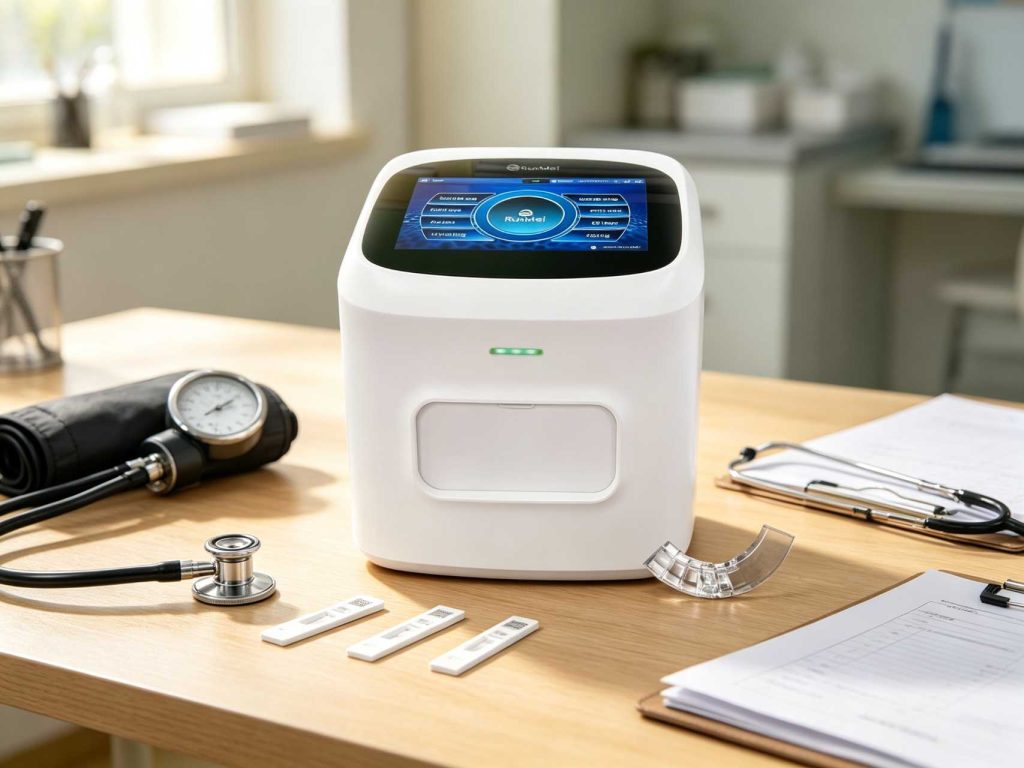
Fig. 1 — RunMei best value hematology analyzer in a rural clinic setting. Blood analyzer traditional birth attendant antenatal hemoglobin testing. | Alt: blood analyzer traditional birth attendant antenatal hemoglobin testing
Training the Attendant to Use the Analyzer
Task sharing works when the task is honestly simple: a finger-prick sample, a machine that reads it, and a protocol that says what to do with the result. Structured training turns the attendant into a screening point, not a diagnostician, and that division of labor is the strength of the model.
The attendant does not interpret disease; she recognizes the abnormal, refers with the number, and documents in the register the clinic audits. the blood analyzer stays simple; the protocol stays short; the safety stays in the referral link.
None of this happens without people. The clinic that treats the blood analyzer as a machine buys a machine; the clinic that treats it as a skill builds a capability. Operators need a hands-on competency pathway, a named backup for every shift, and refresher sessions that follow staff turnover — because in rural health care, the person trained last year may be the person who left, and the person answering for today’s results is the one who was never trained at all. The same principle holds for blood analyzer: measure, record, act. Budget teams should see the best value hematology analyzer cost analysis before signing off on procurement.
The Two-Color Protocol
The simplest protocols run on colors: green means proceed and follow the schedule, red means refer with the number. The attendant needs no laboratory training to act on a threshold she has memorized.
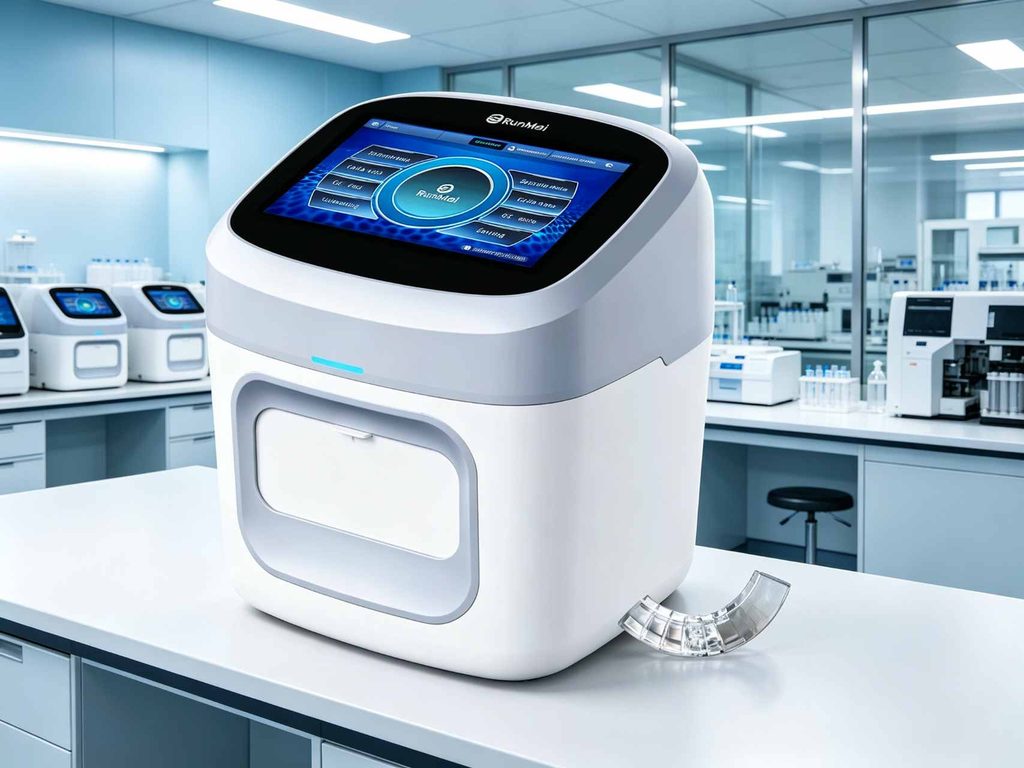
Fig. 2 — RunMei mobile blood analyzer during routine testing. Compact blood analyzer village maternity screening finger prick. | Alt: compact blood analyzer village maternity screening finger prick
The Chain From Hut to Clinic
The village maternity chain has three links: the attendant who screens, the clinic that confirms and treats, and the referral facility for the high-risk mother. the blood analyzer strengthens the first link, which strengthens the whole chain, because the clinic receives mothers with numbers instead of worries.
The register that starts in the village travels with the mother. The clinic sees the antenatal trend, the delivery outcome returns to the village, and the loop closes with data instead of folklore.
Results become evidence only when they are recorded. A register — patient, date, count, action taken — turns a stream of tests into a picture of the community’s health, and that picture is what justifies the program’s continuation. Clinics that keep the register find it writes their own case for support. blood analyzer is the blood analyzer at the center of that workflow.
The Register That Connects Two Worlds
The village register and the clinic register are two halves of one record. The number the attendant writes at the antenatal visit is the number the clinic reads at the review, and the mother is the document that carries it between them.
The Referral Design
the blood analyzer changes where the referral line is drawn. With blood analyzer in place, routine monitoring stays local and referral reserves itself for what the clinic cannot do: confirmatory testing, specialist review, severe or complicated cases. The design work is agreeing the line — in writing, with the district — before the machine goes live.
The same pattern repeats in facility after facility: the clinic that measures its own patients keeps them, and the clinic that sends them away loses them. That arithmetic changes inside the first year, not through gadget appeal, but through fewer referrals, fewer repeat visits and a patient list that finally trusts the results it is given.
What Stays Local
Routine counts, serial monitoring and treatment follow-up stay local once the results are trustworthy. The clinic that can show its controls and its register earns the right to keep these cases — and the district earns back its referral capacity for the cases that genuinely need it.
What Travels With the Patient
When referral is needed, the result travels: the count, the date, the trend if there is one, the treatment already given. A referral with the numbers attached changes what the receiving clinician can do on arrival — and the register is what makes the attachment routine.
Decisions about traditional birth attendant training are usually made at district level — and the register feeds them. It also strengthens community maternity testing, a benefit that rarely appears in the budget line. None of this holds together without attention to antenatal hemoglobin village.
الأسئلة المتداولة
Q1. Can a traditional birth attendant use a blood analyzer?
With structured training on a simple, protocol-driven model, the screening task is well within her reach. The clinician retains interpretation and treatment.
Q2. Which test matters most at the antenatal visit?
The hemoglobin. Anemia in pregnancy is common, measurable and central to delivery safety, and the count is the referral trigger.
Q3. How is the result used?
The threshold protocol decides: normal counts follow the schedule, low counts refer with the number, and the register carries the trend.
Q4. Is this safe without a clinician present?
The model is safe when the attendant’s role is limited to screening and referral under a written protocol reviewed by the clinic.
Sources & References
- World Health Organization data show that in lower-income countries a large share of the rural population still lives beyond the reach of a functioning laboratory; the WHO recommends primary care facilities be reachable within roughly 5 km, yet global estimates indicate about 3 billion people cannot reach a health facility within one hour on foot. Source: WHO — https://www.who.int/news-room/fact-sheets/detail/primary-health-care
- WHO analyses indicate that anemia affects roughly one in four people worldwide, with the highest prevalence in preschool children and pregnant women in low- and middle-income regions. Source: WHO — https://www.who.int/news-room/fact-sheets/detail/anaemia
- Reviews published in the New England Journal of Medicine have repeatedly underlined that the single most reliable way to improve outcomes in low-resource settings is to shorten the interval between clinical presentation and a correct laboratory diagnosis. Source: NEJM — https://www.nejm.org/
Disclaimer
This article is for informational and marketing purposes only and does not constitute medical advice, a product claim, or a regulatory certification statement. Device availability, regulatory status (FDA 510(k)/CE/ISO 13485) and specifications vary by country and model; always verify current approvals with the manufacturer and consult local regulations before procurement or use.



