Meta Title: CBC Testing for Pneumonia Triage in Respiratory Season | RunMei
Meta Description: CBC Testing. CBC testing to triage pneumonia in respiratory season. White cell counts support the antibiotic and referral decisions for coughing children.
URL: https://runmeihealth.com/cbc-testing-pneumonia-triage-children
By Dr. Elena Marchetti · MD, MPH, Rural Health Diagnostics | Reviewed by Prof. Daniel Mwangi (PhD, MSc, Laboratory Systems Advisor) | Published: 2026-10-1
Respiratory season arrives with the cold wind and the rains, and the clinic queue turns into a corridor of coughing children. The CBC testing question — what it can do, what it costs to run and how a result earns trust — is answered in the pages that follow. The mothers ask the same question with the same eyes: is it serious? The result usually waits on a white cell count that the clinic cannot run. The hospital biochemical analyzer catalog covers the instruments rural programs order most often.
This article looks at CBC testing through the lens of Rural Clinics, where the stakes are ordinary and the constraints are real: budgets that do not stretch, staff who already wear several hats, and distances that punish delay. About 3 billion people worldwide still cannot reach a health facility within one hour on foot, a figure the WHO has used to argue for diagnostics that travel to patients instead of the other way around. The practical questions — which instrument, what training, how much per test, who maintains it — are answered in plain language, with the numbers a procurement committee can actually use. WHO . Facilities weighing the options can browse the 3-part vs 5-part blood analyzer range to compare configurations side by side.
Key Takeaways
- Respiratory season floods rural clinics with undifferentiated fever and cough.
- The CBC supports the triage between viral illness, bacterial infection and observation.
- Same-day white cell counts sharpen antibiotic decisions and referral timing.
- A reliable count reduces both under-treatment and unnecessary referral.
The Corridor of Coughing Children
Every clinic in respiratory season faces the same arithmetic: more sick children than beds, more fever than diagnosis, and a queue that cannot wait for a distant laboratory. The clinician works from signs alone, and signs alone are a blunt instrument for pneumonia.
The white cell count is the laboratory number that adds the most to this decision. Leukocytosis with a left shift supports bacterial infection; a normal or low count points elsewhere. The count does not diagnose pneumonia, but it grades the suspicion.
the cbc testing is the seed; the program is the tree. Training, supervision, registers, quality checks and a supply line that outlasts the donor — these are what turn a machine into a service that keeps running. Programs that design for sustainability from the first installation meeting are the ones still running at the five-year review. That is the practical reality of CBC testing in the field. NEJM . Programs that want a deeper differential can read the mobile blood analyzer page for the trade-offs.
The Fever Without a Focus
The child with fever and cough who is not obviously distressed is the difficult case. The count separates the child who needs antibiotics and observation from the child who can go home with advice and a recheck date.
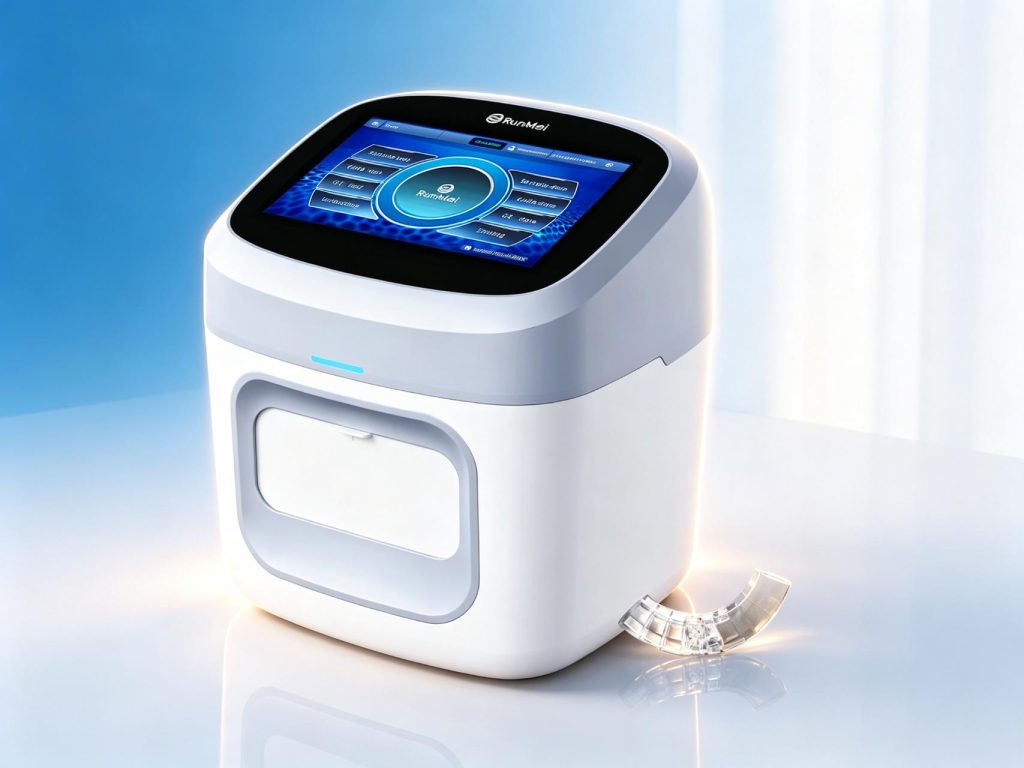
Fig. 1 — RunMei mobile blood analyze in a rural clinic setting. Cbc testing blood analyzer pneumonia triage rural clinic children. | Alt: CBC testing blood analyzer pneumonia triage rural clinic children
The Antibiotic Decision the Count Supports
Antibiotic use in respiratory season is a battlefield: overuse feeds resistance, and underuse feeds pneumonia deaths. The count gives the clinician a number to lean on between the two risks. It does not replace clinical judgment; it strengthens it.
The same instrument runs the rest of the season’s workload: the malaria test on the child with fever, the hemoglobin on the pale one, the follow-up count on the child being treated.
Power is the silent partner in every rural deployment. In Rural Clinics, outages are not the exception; they are the schedule. The practical answer is a cbc testing that tolerates the interruption — battery capability that finishes the test in progress, a startup that does not lose calibration, and a surge protector between the wall and the machine. Programs that budget for power, not just for the instrument, are the programs whose instruments stay alive. And this is exactly where CBC testing changes the decision. Budget teams should see the blood analyzer instruments cost analysis before signing off on procurement.
The Recheck That Confirms the Turn
The child who started antibiotics returns for a recheck, and a falling white cell count confirms the treatment is working. The clinic that can run the recheck locally closes the loop instead of guessing at the outcome.
The Season’s Plan, Written in Advance
Respiratory season should be planned in the dry months: the cbc testing’s workload, the reagent stock for the peak, the protocol for which children get a count and which get a referral. The plan is what makes the season survivable.
The count is also the season’s memory. The register of white cell counts and outcomes becomes the evidence for next year’s plan: where the referrals went, which cases turned, what the clinic got right.
Trust is built one control run at a time. The daily control, the logged result, the outlier that gets acted on rather than explained away — these are the habits that make a rural result worth acting on. Facilities that document their controls report something else too: staff who believe their own numbers and clinicians who trust them. The logbook is not paperwork; it is the evidence that the cbc testing is telling the truth. Programs built around CBC testing see the effect within the first month.
The After-Season Review
When the rains end, the register answers the review: how many children were tested, how many treated, how many referred, and how the season compared with the last. The analyzer turns a hard season into a lesson.
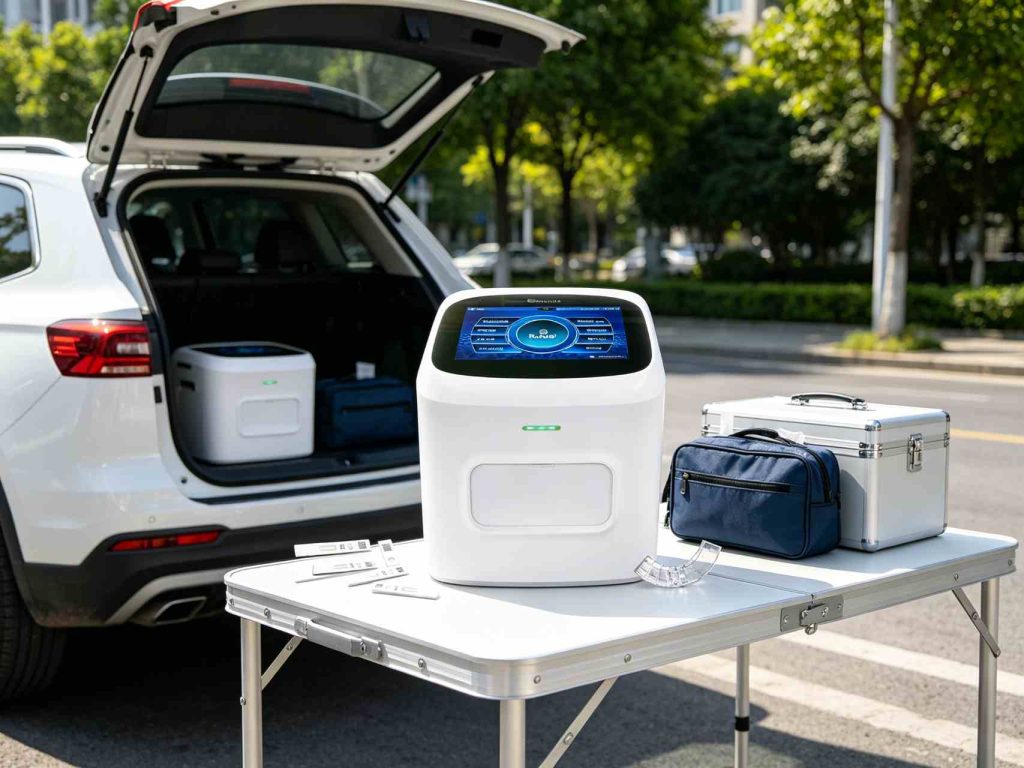
Fig. 2 — RunMei blood analyzer instruments during routine testing. Blood analyzer respiratory season white cell count testing. | Alt: blood analyzer respiratory season white cell count testing
The People Plan
The people plan comes before the cbc testing plan. In Rural Clinics, the operators are likely to be nurses, laboratory assistants or community health workers rather than dedicated technicians — which changes everything about training design. The plan names the operators, the backup operators and the supervisor, and puts a date on each competency milestone before the machine arrives.
The same pattern repeats in facility after facility: the clinic that measures its own patients keeps them, and the clinic that sends them away loses them. That arithmetic changes inside the first year, not through gadget appeal, but through fewer referrals, fewer repeat visits and a patient list that finally trusts the results it is given.
Training That Sticks
Competency is built in stages: observation, supervised practice, independent operation, certification. Each stage is checked, not assumed, and the certification is renewed annually. Programs that compress the stages to fit a schedule end up with operators who can switch the machine on and nothing more.
The Turnover Reserve
Staff turnover is a fact of rural health work, and the plan must budget for it: every shift carries two trained operators, and training slots are scheduled continuously rather than once at installation. The facility that trains continuously is the facility whose capability survives its staff changes.
The same logic applies to childhood pneumonia triage, which clinics in the region often underestimate. For teams accountable for respiratory season clinic, the practical effect shows up within the first month. Decisions about white cell count infection are usually made at district level — and the register feeds them.
الأسئلة المتداولة
Q1. How does the CBC help in pneumonia triage?
The white cell count and its pattern grade the suspicion of bacterial infection, supporting the antibiotic and referral decisions.
Q2. Which children should get a blood count?
Fever with cough that is not resolving, children with breathing difficulty, and any child the clinician judges at risk. The protocol names the criteria.
Q3. Does a normal count rule out pneumonia?
No. It lowers the suspicion but clinical signs remain decisive. The count is one input in a judgment, not the whole judgment.
Q4. Can one analyzer serve a whole respiratory season?
Yes, when reagent stock is planned for the peak and a second operator is trained. The CBC workload of a busy clinic is well within a reliable analyzer’s capacity.
Sources & References
- World Health Organization data show that in lower-income countries a large share of the rural population still lives beyond the reach of a functioning laboratory; the WHO recommends primary care facilities be reachable within roughly 5 km, yet global estimates indicate about 3 billion people cannot reach a health facility within one hour on foot. Source: WHO — https://www.who.int/news-room/fact-sheets/detail/primary-health-care
- Reviews published in the New England Journal of Medicine have repeatedly underlined that the single most reliable way to improve outcomes in low-resource settings is to shorten the interval between clinical presentation and a correct laboratory diagnosis. Source: NEJM — https://www.nejm.org/
- WHO analyses indicate that anemia affects roughly one in four people worldwide, with the highest prevalence in preschool children and pregnant women in low- and middle-income regions. Source: WHO — https://www.who.int/news-room/fact-sheets/detail/anaemia
About the Author & Reviewer
Author: Dr. Elena Marchetti, MD, MPH, Rural Health Diagnostics. Dr. Marchetti is a physician and diagnostics specialist who has spent the past fifteen years designing point-of-care programs for district hospitals and rural clinics in lower-resource settings. Her field work focuses on how laboratory devices survive daily use outside the laboratory, from staff training to reagent logistics.
Reviewer: Prof. Daniel Mwangi, PhD, MSc, Laboratory Systems Advisor. Prof. Mwangi directs laboratory quality programs for a network of rural health facilities and teaches clinical laboratory science. He has reviewed point-of-care device deployments across Africa and Southeast Asia, with a particular interest in quality control and operator competency outside the main laboratory.
Disclaimer
This article is for informational and marketing purposes only and does not constitute medical advice, a product claim, or a regulatory certification statement. Device availability, regulatory status (FDA 510(k)/CE/ISO 13485) and specifications vary by country and model; always verify current approvals with the manufacturer and consult local regulations before procurement or use.