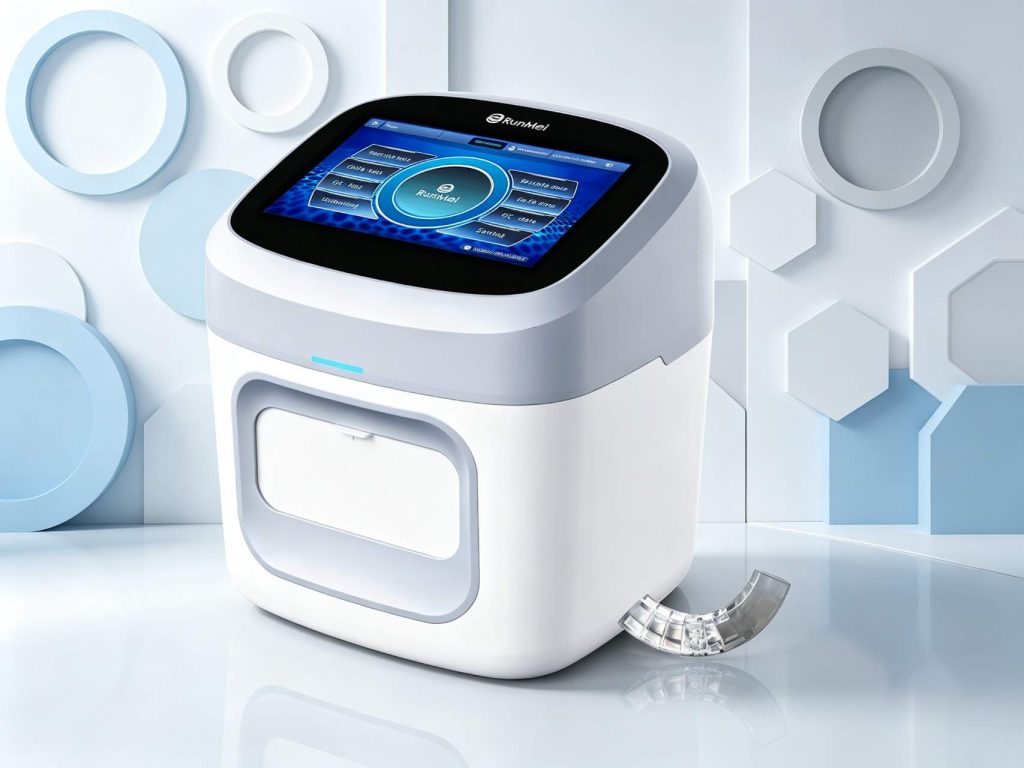
You walk into the testing room, prick a fingertip, press a button, and three minutes later a complete blood count appears on screen. But what actually happens between that drop of blood and the printed report? Understanding how a blood analyzer works equips you to choose the right instrument—and to trust the numbers that shape treatment decisions.
The Sample’s Journey Begins with a Drop
Principle One: Impedance Counting
Most analyzers use the electric impedance (Coulter) principle. Cells pass single-file through a small aperture while an electric current flows across it. Each cell briefly raises resistance, producing a pulse proportional to cell volume. Larger cells create bigger pulses, so the machine estimates both count and size from a single sensor.
Principle Two: Optical Scatter
Advanced five-part analyzers add laser or LED scattering. As cells pass through a beam, light scatters at angles determined by internal complexity and granularity. Combined with impedance data, this distinguishes neutrophils, lymphocytes, monocytes, eosinophils, and basophils—the five-part differential.
Chemical Reactants and Hemoglobin
A lysing reagent breaks open red cells so the machine can measure hemoglobin colorimetrically. Meanwhile the white cell count is taken on the intact fraction. A modern compact CBC machine coordinates these reactions automatically within its cycle. runmeihealth.com explains the chemistry of these consumable packs, and our site details how sealed reagents keep results stable test after test.
How the Blood Analyzer Builds Your Report
Microprocessor software flags abnormal distributions, generates the CBC panel, and can push results to LIS/HIS automatically. This is where connectivity matters—a good محلل أمراض الدم turns raw pulses into a clinician-ready report without transcription errors.
Actionable Tip
Run daily quality-control samples and inspect the scattergram alongside the raw numbers. When a suspicious result appears, repeat the test on a fresh sample before alarming a patient; flags from the analyzer are alerts, not diagnoses.
The Critical Difference: Sample Volume
Traditional hospital-grade machines may require several milliliters of venous blood. Modern compact CBC machine systems reduce this to a capillary drop—a genuine advantage for pediatric and fragile patients who cannot spare volume.
Key Takeaway
Impedance counts and sizes cells; optical scatter classifies them.
Lysing reagent enables colorimetric hemoglobin measurement.
Capillary systems run a full CBC from a single finger-prick drop.
FAQ: Do blood analyzers need frequent calibration?
Sealed-reagent analyzers from Brand A, Brand B, and Brand C require periodic calibration check intervals, typically monthly, which is far gentler than the daily calibration demands of some bench-top systems. Automated quality-control alerts keep the process simple.
Ready to understand your next instrument? Explore our blood analyzer resources today.