Meta Title: Solar-Powered Blood Analyzer | RunMei
Meta Description: Solar-Powered Blood Analyzer. Nearly 15% of sub-Saharan health facilities have no electricity at all. Solar-compatible, low-power blood analyzers keep CBC testing running.
URL: https://runmeihealth.com/solar-powered-blood-analyzer
By Dr. Amara Okafor · MBBS, MSc Global Health Diagnostics | Reviewed by Dr. Michael Chen (PhD, Senior Laboratory Advisor) | Published: 2026-10-06
The lab in a health post in rural Malawi has a sign on the wall: ‘No power today, come tomorrow.’ Tomorrow, sometimes, there is no power either. The solar-powered blood analyzer question — what it can do, what it costs to run and how a result earns trust — is answered in the pages that follow. For health facilities serving nearly a billion people in low- and middle-income countries, electricity is not an amenity — it is a diagnostic on/off switch. The instrument changing that equation is a portable blood analyzer that sips power instead of demanding it.
This article looks at solar-powered blood analyzer through the lens of rural health care, where the stakes are ordinary and the constraints are real: budgets that do not stretch, staff who already wear several hats, and distances that punish delay. According to the WHO, health facilities serving close to one billion people in low- and middle-income countries lack reliable electricity or have none at all — roughly 12% of facilities in South Asia and 15% in sub-Saharan Africa are completely unelectrified. The practical questions — which instrument, what training, how much per test, who maintains it — are answered in plain language, with the numbers a procurement committee can actually use. Programs that want a deeper differential can read the hospital biochemical analyzer page for the trade-offs.
Key Takeaways
- An estimated 15% of health facilities in sub-Saharan Africa have no electricity at all.
- Low-power analyzers (under 100 W) can run on solar panels and battery storage, not a grid.
- Battery-tolerant design means a power cut mid-test does not destroy the sample or the result.
- Solar kits for analyzers cost far less than grid extension and can be installed by local technicians.
The Electricity Gap in Numbers
The WHO’s own figures are stark: health facilities serving close to one billion people in low- and middle-income countries lack reliable electricity or have none at all, with about 12% of facilities in South Asia and 15% in sub-Saharan Africa completely unelectrified. For a rural clinic, that statistic translates into refrigerators that cannot hold reagents, microscopes that cannot be used after dusk, and analyzers that sit idle.
Power is the silent partner in every rural deployment. In rural health care, outages are not the exception; they are the schedule. The practical answer is a solar-powered blood analyzer that tolerates the interruption — battery capability that finishes the test in progress, a startup that does not lose calibration, and a surge protector between the wall and the machine. Programs that budget for power, not just for the instrument, are the programs whose instruments stay alive. solar-powered blood analyzer is the instrument at the center of that workflow. Budget teams should see the open-channel blood analyzer cost analysis before signing off on procurement.
Why Big Analyzers Fail Off the Grid
Hospital-grade analyzers are built for a world of stable power. They draw hundreds of watts, need compressors and constant voltage, and their electronics do not forgive brownouts. Off-grid clinics that received donated big machines learned this the hard way: the devices now sit in corners collecting dust, waiting for a generator that runs out of fuel.

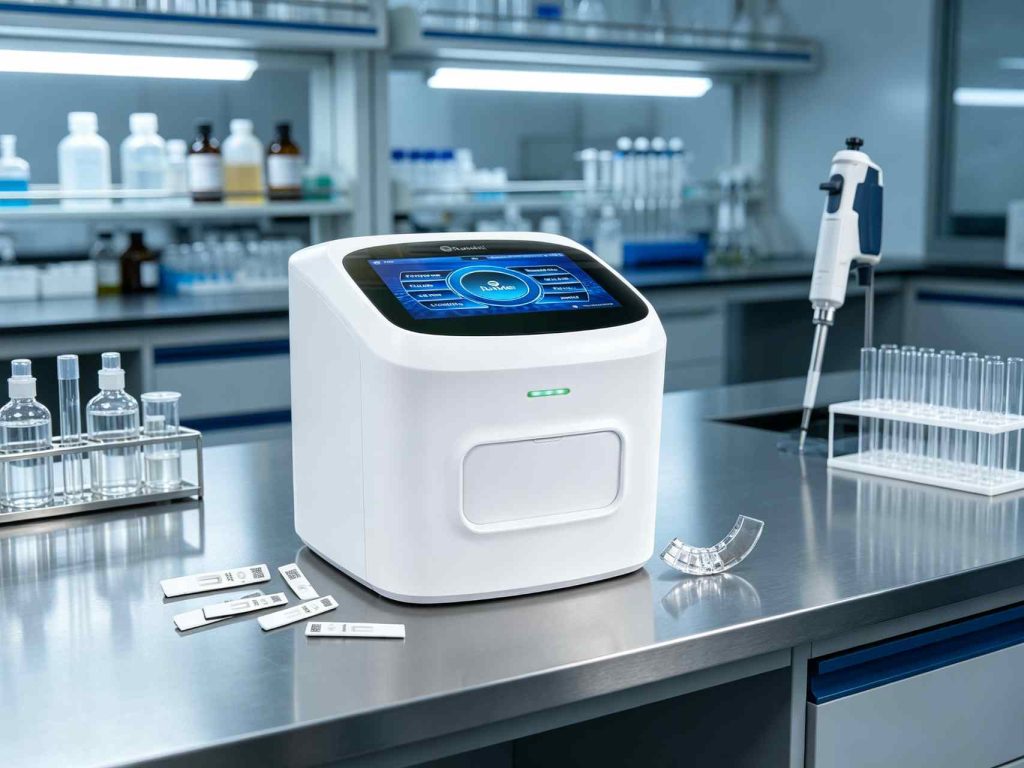
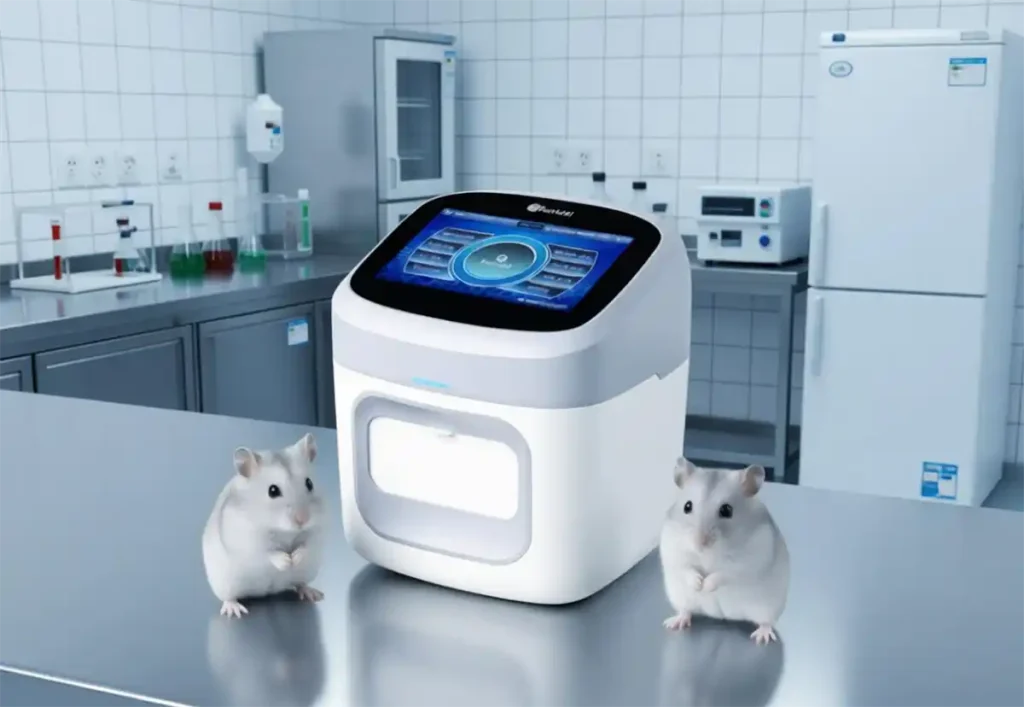
Fig. 1 — RunMei open-channel blood analyzer in a rural clinic setting. Solar powered blood analyzer off-grid clinic. | Alt: solar powered blood analyzer off-grid clinic
What Off-Grid Hematology Looks Like Today
The workable model couples a compact, low-power محلل أمراض الدم with a modest solar kit: a 200–400 W panel, a battery and a charge controller, all installable in a day. the solar-powered blood analyzer draws so little that a single panel keeps it running through a clinic’s working hours, and the battery carries it through the evening hours when mothers bring children after farm work.
Results become evidence only when they are recorded. A register — patient, date, count, action taken — turns a stream of tests into a picture of the community’s health, and that picture is what justifies the program’s continuation. Clinics that keep the register find it writes their own case for support. Facilities that already run solar-powered blood analyzer report the same pattern.
Battery Built-In Beats Battery Backup
The more robust designs do not just tolerate power loss — they run on internal battery during a cut and finish the test already in progress. That detail matters enormously in practice: losing a sample mid-run because the grid blinked is not just a nuisance, it is a patient who must be re-bled.
Sizing a Solar System for a Rural Lab
A practical rule of thumb: total the wattage of the solar-powered blood analyzer, a small fridge for reagents and LED lighting; multiply by hours of use; then size the panel and battery for two days of autonomy, because the sun will not always cooperate. Local solar vendors can do this calculation, and several NGOs now bundle analyzer-plus-solar packages for off-grid facilities.
Maintenance is the part most programs forget. Solar kits need quarterly checks — panel cleaning, battery water, connection tightening — and a local person trained to do them. A system that is not maintained quietly dies, and the solar-powered blood analyzer dies with it.
The maintenance calendar is short, posted and owned: daily checks, weekly cleaning, quarterly deep service, with a name on every line. In facilities without a biomedical engineer, these routines are the entire maintenance system — and they are enough, when someone owns them. the solar-powered blood analyzer that is cleaned on schedule is the machine that does not fail on the day it matters. That is the practical reality of solar-powered blood analyzer in the field.
Realistic Operating Costs
A solar kit sized for one analyzer and minimal lab load typically costs a fraction of one year’s diesel for a small generator, with near-zero fuel costs after installation. Open-channel reagents keep the per-test consumable cost low, so the full system — sun, battery and analyzer — runs on a recurring cost that a rural health budget can actually sustain.
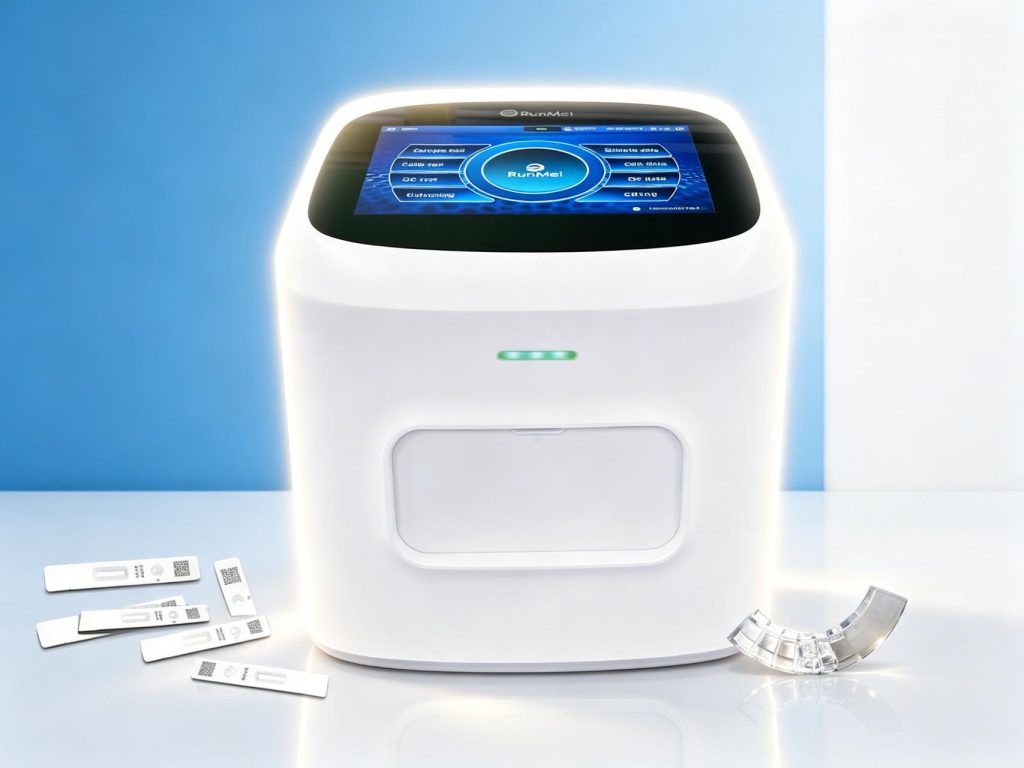
Fig. 2 — RunMei hospital biochemical analyzer in a rural clinic setting. Battery operated blood analyzer solar kit. | Alt: battery operated blood analyzer solar kit
The People Plan
The people plan comes before the solar-powered blood analyzer plan. In rural health care, the operators are likely to be nurses, laboratory assistants or community health workers rather than dedicated technicians — which changes everything about training design. The plan names the operators, the backup operators and the supervisor, and puts a date on each competency milestone before the machine arrives. And this is exactly where solar-powered blood analyzer changes the decision.
Training That Sticks
Competency is built in stages: observation, supervised practice, independent operation, certification. Each stage is checked, not assumed, and the certification is renewed annually. Programs that compress the stages to fit a schedule end up with operators who can switch the machine on and nothing more.
The Turnover Reserve
Staff turnover is a fact of rural health work, and the plan must budget for it: every shift carries two trained operators, and training slots are scheduled continuously rather than once at installation. The facility that trains continuously is the facility whose capability survives its staff changes.
None of this holds together without attention to off-grid clinic diagnostics. Programs that pair solar-powered blood analyzer with low power analyzer report the strongest results. The same logic applies to battery operated blood analyzer, which clinics in the region often underestimate.
الأسئلة المتداولة
Q1. Can blood analyzers really run on solar power?
Yes, when the analyzer is designed for low power draw (under about 100 W) and can run on battery. A modest solar kit with a battery and charge controller is enough to operate it through a clinic’s working day.
Q2. What happens to a test if the power cuts mid-run?
Analyzers with built-in batteries finish the test already in progress and continue operating during short outages. Models without this feature can lose the run and require a fresh sample.
Q3. How much electricity does a portable blood analyzer use?
Most portable analyzers draw between 30 and 100 watts, comparable to a small laptop. That is why they are suitable for solar and battery operation where hospital-grade machines are not.
Q4. What size solar kit does an off-grid clinic need?
A system sized for the analyzer plus basic lab loads (small fridge, lighting) is typically 200–400 W of panels with a battery sized for two days of autonomy. Ask the supplier for a load calculation before purchase.
Sources & References
- According to the WHO, health facilities serving close to one billion people in low- and middle-income countries lack reliable electricity or have none at all, with roughly 12% of facilities in South Asia and 15% in sub-Saharan Africa completely unelectrified.
- World Health Organization data show that in lower-income countries a large share of the rural population still lives beyond the reach of a functioning laboratory; the WHO recommends primary care facilities be reachable within roughly 5 km, yet global estimates indicate about 3 billion people cannot reach a health facility within one hour on foot.
About the Author & Reviewer
Author: Dr. Amara Okafor, MBBS, MSc Global Health Diagnostics. Dr. Okafor is a physician and diagnostics specialist who has supported laboratory capacity projects across East Africa for over a decade.
Reviewer: Dr. Michael Chen, PhD, Senior Laboratory Advisor. Dr. Chen advises public health laboratories on quality systems and point-of-care device deployment in low-resource settings.
Disclaimer
This article is for informational and marketing purposes only and does not constitute medical advice, a product claim, or a regulatory certification statement. Device availability, regulatory status and specifications vary by country and model; always verify current approvals with the manufacturer and consult local regulations before procurement or use.